How to Eliminate Smoke Odor from a Car Interior
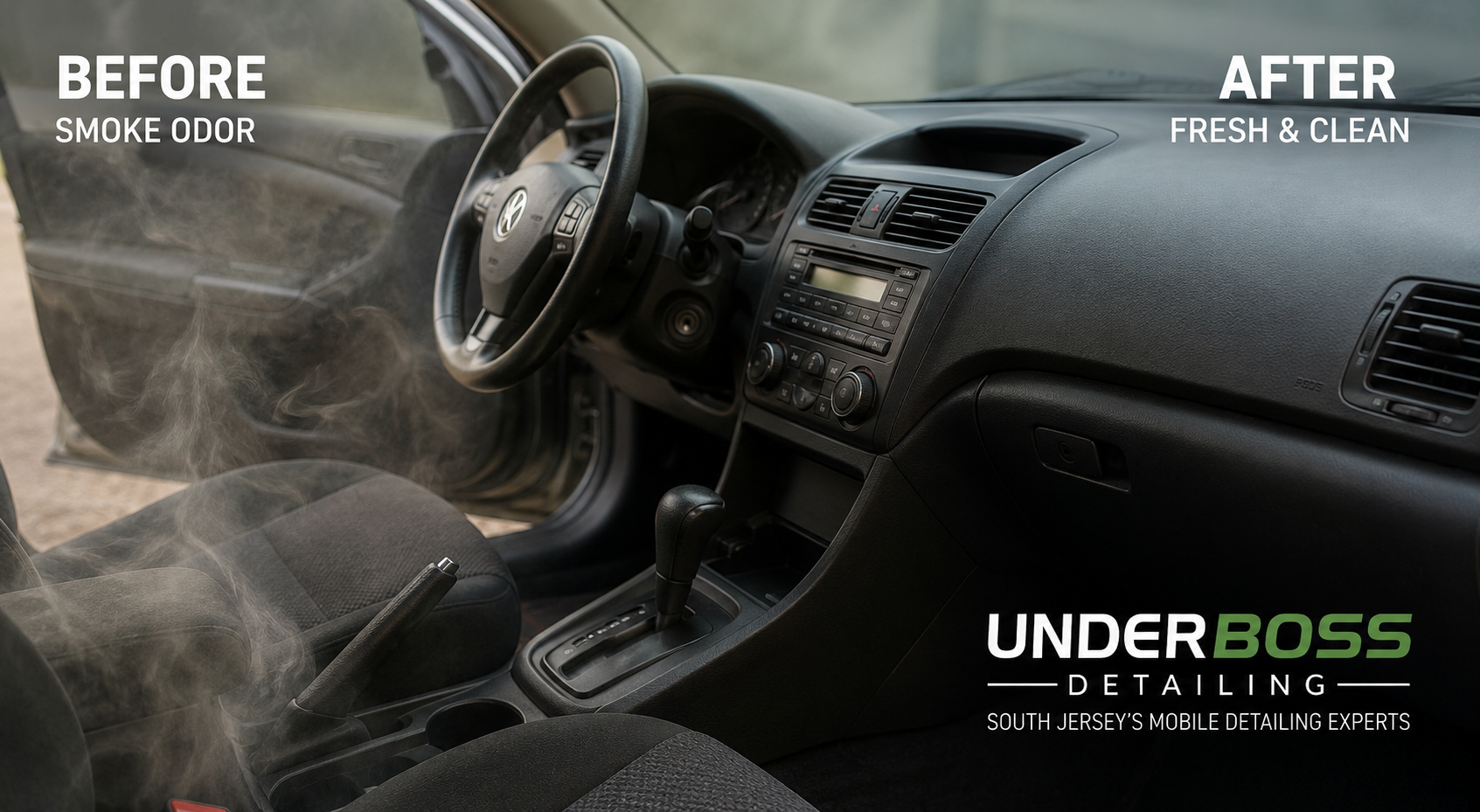
Why Air Fresheners Don't Work — And What Actually Does
You've tried the pine tree hanging from the mirror. You've tried the sprays, the baking soda, the charcoal bags. Maybe you've left the windows down for days hoping fresh air would flush it out. And yet, the moment you close the doors and turn on the heat, that smoke smell is right back.
This is one of the most common — and most frustrating — interior detailing problems there is. People who inherit a used car from a smoker deal with it. People who smoked in their own vehicle for years and then quit deal with it. People who bought a used car and missed the telltale signs at the dealership deal with it.
The reason nothing seems to work isn't that the smell is impossible to eliminate. It's that most approaches target the wrong thing. Smoke odor isn't just a smell floating in the air — it's a physical residue chemically bonded to every surface inside the car. Until you address the residue, no amount of masking or absorbing will produce lasting results. This guide explains what's actually happening, why, and what the correct professional process looks like from start to finish.
The Science Behind Why Smoke Smell Is So Stubborn
Understanding why smoke odor is uniquely persistent changes how you approach removing it.
What makes cigarette odor especially stubborn is what's often referred to as thirdhand smoke — the residue left behind after visible smoke clears. These particles cling to materials and remain long after the cigarette is extinguished. When temperatures rise or humidity increases, those residues release volatile compounds back into the air. Chemical Guys
Cigarette smoke contains thousands of chemicals, including tar and nicotine. These compounds, classified as semi-volatile, slowly transition from a gas state to a solid state. They readily adhere to and permeate porous surfaces and plastic polymers inside the vehicle, creating a layer known as thirdhand smoke residue. This residue acts as a continuous source of odor — a process called off-gassing — where the chemicals are released slowly into the car's cabin air over time. CarXplorer
In practical terms, this means that every time your car sits in the sun, the interior heats up, and that heat causes the embedded residue in your seats, carpet, headliner, and door panels to off-gas right back into the cabin. Open the windows, air it out, and it might seem better temporarily — but close it up again and the cycle restarts.
Your car's interior creates the perfect environment for odor to linger. It's an enclosed space filled with porous materials and constant airflow. Fabric seats absorb smoke like a sponge. Headliners trap rising smoke. Foam padding beneath upholstery can soak up residue that can sit undisturbed for months. Even hard plastics and vinyl surfaces develop a thin film of tar and nicotine over time. Chemical Guys
Thirdhand smoke chemical residue can linger for years in dust and on surfaces. It becomes embedded in carpets, fabrics, and materials, and is difficult and expensive to remove. Thirdhand Smoke Resource Center
This is why air fresheners, baking soda, and ventilation fail as permanent solutions. Baking soda and charcoal absorb some airborne odor but can't pull nicotine residue from foam cushions or clean duct interiors. They address the symptom — the smell in the air — without touching the source — the residue on every surface. Fresh Layer
The Three Things That Must Happen for Smoke Odor to Be Permanently Eliminated
To successfully remove cigarette smoke odor from a vehicle, you need to focus on three key steps. First, break down and remove the tar and nicotine buildup from all surfaces. Second, extract contamination from fabrics and soft materials. Third, neutralize any remaining odor using a method like ozone treatment. Skipping any of these steps usually leads to incomplete results and the odor returning over time. Auto Detail Doctor
This three-part framework is the difference between a car that smells better for a week and one that's genuinely, permanently clean. Let's walk through each step in detail.
Step 1: Remove Every Physical Source of Odor
Before any cleaning begins, every item that's carrying smoke residue needs to come out of the vehicle or be addressed directly.
Start by removing all personal items, trash, and clutter from the car. Ashtrays, cigarette packs, lighters, and even fast food wrappers can hold onto smoke particles and continue to emit odors. If the car has an ashtray, empty it thoroughly. Old residue can stink up the cabin even if it's no longer in use. Smoke particles can settle in hidden places — use a flashlight to check under seats, in storage compartments, and between cushions for any remaining items or residue. Chemical Guys
Floor mats come out entirely and are treated separately, since they absorb more smoke residue per square inch than almost any other surface due to their dense fiber construction and proximity to the ashtray area.
Step 2: Thorough Vacuum of Every Surface
Start by vacuuming everything: seats, carpet, floor mats, the headliner, and the area under the seats. Use a crevice tool to get into seat seams where ash and residue collect. Fresh Layer
The headliner deserves particular attention here. Smoke rises — which means every cigarette smoked in the vehicle deposited the densest concentration of tar and nicotine directly into the headliner fabric above. The headliner can turn yellow from heavy nicotine and tar buildup, and it's the surface that most DIY attempts neglect entirely. Vacuuming the headliner with an upholstery brush attachment is essential before any wet treatment goes anywhere near it — excessive moisture in the headliner can loosen the adhesive that bonds the fabric to the backing board. Auto Detail Doctor
Step 3: Clean All Hard Surfaces with an Interior Cleaner
After vacuuming, wipe down all hard surfaces — dashboard, door panels, center console, and the steering wheel — with an all-purpose interior cleaner. This removes surface-level residue before you move to deeper treatments. Fresh Layer
This step matters because hard surfaces — plastic, vinyl, glass, and rubber — all carry a film of nicotine and tar residue that's invisible but actively off-gassing. A thorough wipe-down with a proper interior cleaner, using microfiber cloths and working into crevices and textured surfaces, removes that film and reduces the total odor load significantly before the fabric treatments begin.
The windows also need specific attention. The interior of the windshield and side glass develops a yellowish-brown nicotine haze over time in a heavily smoked-in vehicle — visible in direct sunlight as a film that standard glass cleaner barely touches. A dedicated glass cleaner with a cutting agent removes it properly.
Step 4: Replace the Cabin Air Filter — The Most Commonly Skipped Step
This step gets skipped constantly, and it's one reason DIY odor removal often fails. The cabin air filter is typically located behind the glove box. In a heavily smoked-in car, it will be saturated with smoke particles and will keep recirculating that odor through the vents no matter how well you clean the visible interior. Cabin filters run $15 to $40 and take 15 minutes to replace. Fresh Layer
The car's air conditioning and heating system is one of the most overlooked sources of smoke odor. Smoke particles accumulate on the evaporator coil, in ductwork, and on the cabin air filter, re-releasing odor every time the system runs. Chemical Guys
This is the single most impactful $15 to $40 investment in the entire smoke removal process. A perfectly detailed interior will still smell like smoke every time you run the HVAC if the cabin filter and ductwork haven't been addressed. After replacing the filter, an odor eliminator sprayed directly into the exterior air intake vents while the system runs in recirculation mode treats the internal ductwork from the inside out.
Step 5: Steam Clean the Fabrics and Upholstery
Steam cleaning is the bridge between surface cleaning and deep extraction — and it's where most DIY attempts genuinely can't match professional results.
Steam cleaning is one of the most effective ways to remove the smoke smell from a car. High-temperature steam loosens particles stuck in upholstery and carpets, allowing them to be removed completely. Obsesseddetailandrestoration
Steam cleaning works particularly well as a preparatory step before applying an enzyme-based odor treatment on heavily saturated upholstery. The heat from professional-grade steam penetrates fabric fibers, loosening the tar and nicotine residue that's been bonded into them over months or years of exposure. That loosened residue can then be extracted — actually removed from the material rather than just redistributed or masked. Chemical Guys
Steam cleaning the headliner, seats, door panel fabric, and carpet in sequence — using proper technique to avoid oversaturation — addresses the deep contamination that vacuuming and surface cleaning leave behind.
Step 6: Enzyme Treatment for Organic Odor Compounds
Enzyme-based cleaners work differently from standard interior cleaners. They contain biological compounds that actively break down the organic molecules responsible for odor — including the protein-based components of smoke residue — rather than simply dissolving them off surfaces.
For smoke odor, the most effective sequence is: clean all surfaces first, replace the cabin air filter, then run an ozone treatment to reach fabrics and HVAC ducts. Enzyme cleaning addresses the organic residue at the source. Jimbo's Detailing
Applied to seats, carpet, and floor mats after steam cleaning — while the fibers are open and receptive from the steam treatment — enzyme cleaners reach into the foam padding and deep fibers where steam alone may not fully penetrate. The dwell time matters: allowing the enzyme cleaner to sit for the recommended period before extraction gives the biological compounds time to break down the odor-causing residue at the molecular level.
Step 7: Ozone Treatment for Severe or Persistent Cases
For vehicles with heavy, long-term smoke exposure — a car smoked in daily for years, a purchase with an overwhelming odor — steam cleaning and enzyme treatment alone may not be enough. This is where ozone treatment becomes the professional's tool of choice.
For severe smoke contamination, ozone treatment is one of the most powerful options available. Ozone generators produce O3, which reacts with and oxidizes smoke compounds on contact, neutralizing them at the molecular level. Ozone reaches every surface, including vents, foam padding, and recessed areas that manual cleaning cannot access. Chemical Guys
Smoke odor responds better to ozone than any other method. Vehicles that were chain-smoked in for years can be restored to a completely fresh state. The results are long-lasting because ozone neutralizes the source of the odor rather than just covering it up. Fresh Layer
One important caveat: ozone treatment must be performed correctly. Ozone is harmful to breathe and requires the space to be fully unoccupied during treatment and thoroughly ventilated before re-entry. Extended ozone exposure can also degrade rubber seals and fade some plastics, so treatments should be kept to recommended durations. Chemical Guys
This is why ozone treatment is best handled by a professional detailer rather than attempted with consumer-grade equipment. Done right, it's the most complete odor elimination available. Done wrong, it can damage interior materials and leave chemical residues that create new problems.
What Doesn't Work — And Why People Keep Trying It
Air fresheners are the universal first response to smoke odor, and they're essentially useless for anything beyond masking. Air fresheners release fragrance to mask odors, with effectiveness lasting only hours to days. They're best suited for light odors or short-term situations. A smoked-in car with an air freshener smells like smoke and pine tree — which is arguably worse. Dennis Auto Details
Baking soda and charcoal absorbers work on a principle of absorption — drawing airborne odor molecules into their structure. They provide some improvement for mild odors but have no mechanism for pulling residue out of foam cushions, carpet backing, or HVAC ductwork. Charcoal and baking soda absorbers achieve moderate effectiveness over days to weeks and are best suited for prevention and mild odors. Dennis Auto Details
"Odor bomb" aerosols that flood the cabin with fragrance compounds have the same fundamental limitation as air fresheners — they address airborne odor, not bonded residue — with the added issue of leaving their own chemical smell layered on top.
The Resale Value Case for Professional Smoke Odor Removal
If you're planning to sell a vehicle that's been smoked in, the financial argument for professional odor removal is clear.
A study by the National Center for Biotechnology Information (NCBI) estimates that smoking in a car reduces its resale value by 7.7%. For a car with a trade-in value of $20,000, that translates to $1,540 less. Online used-car retailer Vroom's appraisal tool reduced the purchase offer on a smoked-in vehicle by $1,000 compared to the identical non-smoked vehicle. Nasdaq
Smoking can be a deal breaker if you're trying to sell a car and a potential buyer sniffs the telltale smoke odor. There also might be signs of visible damage, including burn marks on upholstery that are expensive to repair. Nasdaq
Professional smoke odor removal costs a fraction of what the smell costs you at sale time. A thorough interior detail with ozone treatment that fully eliminates the odor repositions the vehicle entirely in the used car market — from a specialized "smoker's car" that most buyers walk away from to a clean, odor-free vehicle that commands market rate.
Smoke Odor You Inherited — The Used Car Scenario
Buying a used car and discovering it was smoked in is one of the most common scenarios Underboss Detailing encounters. Sometimes it's obvious at the test drive. More often, it's subtle — the dealer detailed it, sprayed it down, put an air freshener in — and the odor only becomes apparent after you've driven it home, parked in the sun for a week, and turned the heat on for the first time.
Smoke will permeate the entire vehicle interior — even in areas you can neither see nor reach, such as inside the air conditioning system. Dealers know this. Surface cleaning before sale addresses the obvious, but the residue in the foam, the ductwork, and the headliner is still there. It just needs a little heat to remind you. Nasdaq
The good news is that even severely smoked-in vehicles can be fully restored with the right process. The worse the contamination, the more treatment cycles may be needed — mild contamination typically clears after one treatment cycle, while heavy long-term smoke exposure may require multiple applications over several days before the odor fully subsides — but complete elimination is achievable. Chemical Guys
How Long Does Professional Smoke Odor Removal Last?
When done correctly — addressing all surfaces, replacing the cabin filter, steam cleaning, and applying ozone treatment — professional smoke odor removal produces permanent results rather than temporary masking.
The caveat is the source. If the vehicle continues to be smoked in after treatment, residue will begin building back up immediately. And if someone who smokes rides in the vehicle regularly, clothing saturated with smoke releases compounds into the cabin during every drive, shortening the results between treatment cycles without addressing the external source. Chemical Guys
For a vehicle that was smoked in and then the smoking stopped — or a used car purchase — a professional treatment performed correctly is the last time it needs to be treated for smoke odor.
Let Underboss Detailing Reset Your Interior
Smoke odor is the interior detailing problem that most DIY approaches can't fully solve — not because it's impossible, but because it requires professional equipment, the right products, and the right sequence applied to every surface including the ones you can't see. Half measures produce half results. A complete professional treatment eliminates the odor at its source and restores the cabin to a genuinely clean, fresh baseline.
Underboss Detailing serves South Jersey and the greater Philadelphia area with mobile interior detail services — including smoke odor elimination — performed at your home, your office, or wherever works for you. No shop drop-off. No waiting around. Just professional results delivered to your driveway.
If your car smells like smoke, there's a fix. Book your interior detail today at underbossdetailing.com and drive something that actually smells clean.
Frequently Asked Questions
Why does smoke smell keep coming back even after cleaning?
Cigarette odor is stubborn because of thirdhand smoke — the residue left behind after visible smoke clears. These particles cling to materials and remain long after the cigarette is extinguished. When temperatures rise or humidity increases, those residues release volatile compounds back into the air. Surface cleaning and air fresheners don't address the residue itself, which is why the smell returns. Chemical Guys
Do air fresheners or baking soda get rid of smoke smell in a car?
No — not permanently. Air fresheners mask airborne odor for hours to days without addressing the residue bonded to surfaces. Baking soda and charcoal absorbers help with mild surface odors but can't extract nicotine residue from foam padding, carpet fibers, or HVAC ductwork. Permanent removal requires breaking down and extracting the physical residue itself.
What is the most effective method for removing cigarette smoke from a car?
For severe or long-standing smoke odor, the most effective approach combines thorough cleaning of all surfaces, cabin air filter replacement, steam cleaning of all fabric surfaces, enzyme treatment, and ozone treatment. Skipping any of these steps usually leads to incomplete results and the odor returning over time. Auto Detail Doctor
Is ozone treatment safe for car interiors?
When performed correctly and for the right duration, yes. Ozone is harmful to breathe and requires the space to be fully unoccupied during treatment and thoroughly ventilated before re-entry. Extended ozone exposure can degrade rubber seals and fade some plastics, so treatments should be kept to recommended durations. Professional detailers understand these limits and apply ozone treatment safely and effectively. Chemical Guys
Can a heavily smoked-in car really be fully deodorized?
Yes. Vehicles that were chain-smoked in for years can be restored to a completely fresh state with the right treatment. The results are long-lasting because ozone neutralizes the source of the odor rather than just covering it up. Severe cases may require multiple treatment cycles, but complete elimination is achievable. Fresh Layer
Does smoke odor affect my car's resale value?
Significantly. An NCBI study estimates that smoking in a car reduces its resale value by 7.7% — on a $20,000 vehicle, that's $1,540 less. Online car retailers reduce their offers by $1,000 or more for smoked-in vehicles, and smoke odor can be a complete deal breaker for many buyers. Professional odor removal typically costs a fraction of what the smell costs at sale time. Nasdaq
Why does the cabin air filter matter for smoke odor removal?
Smoke particles accumulate on the evaporator coil, in ductwork, and on the cabin air filter, re-releasing odor every time the HVAC system runs. A perfectly detailed interior will still smell like smoke every time you use the heat or air conditioning if the cabin filter and ductwork haven't been addressed. Replacing the filter is the single cheapest and most impactful step in the entire process. Chemical Guys
How is smoke odor removal different for leather vs. fabric seats?
Leather interiors require a gentle leather cleaner and conditioner instead of steam to prevent drying or cracking. Fabric allows for deeper enzyme and steam penetration and typically achieves more complete odor removal per treatment cycle. Both require the same full process — cleaning all hard surfaces, replacing the cabin filter, and treating the HVAC system — regardless of seat material. Semper Fi