How to Tell If Your Car Needs a Paint Decontamination Treatment
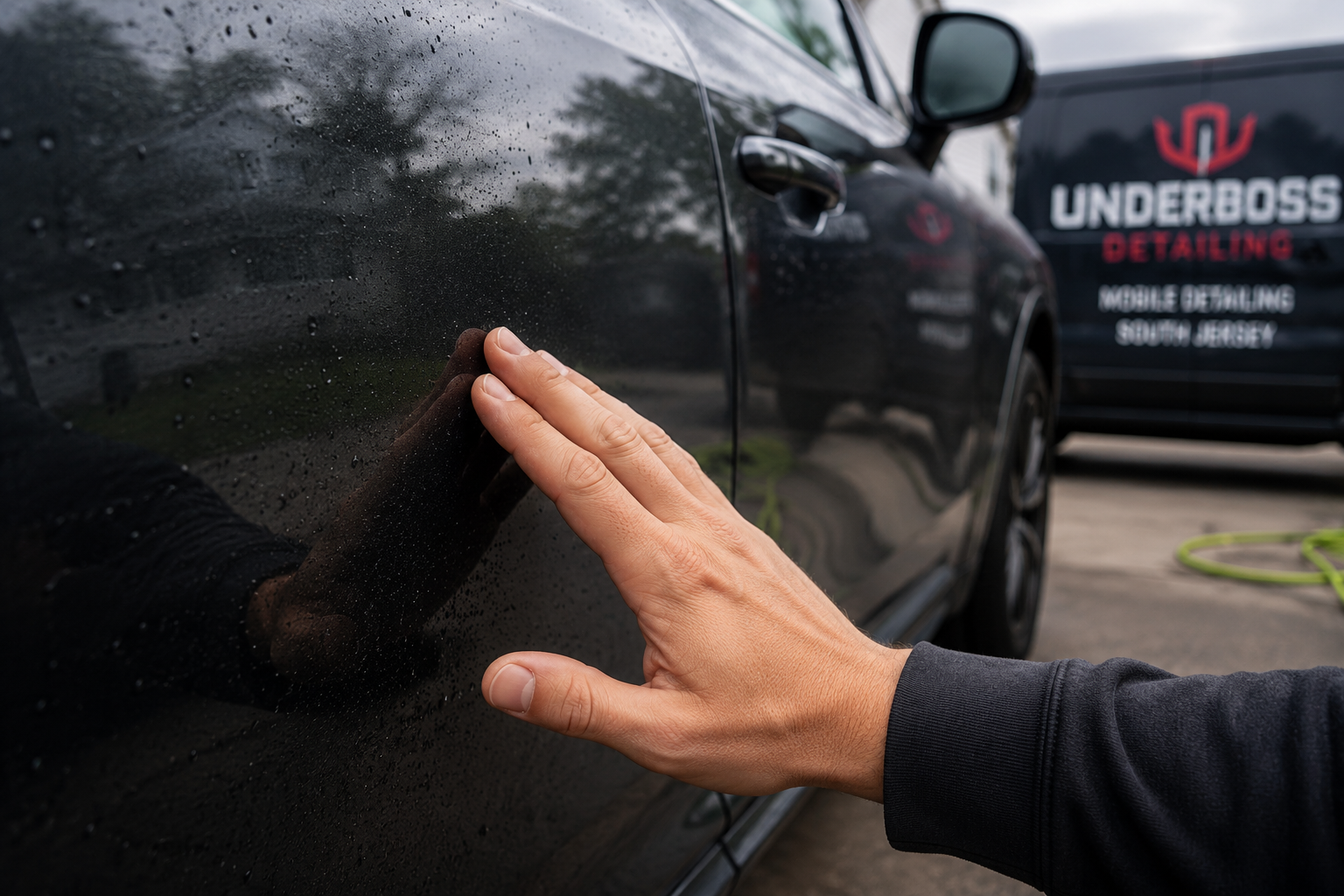
Your Car Looks Clean. Your Paint Disagrees.
You washed the car this weekend. It's shining in the driveway and looks the best it has in months. You're satisfied.
Then you run your hand across the hood.
It doesn't feel the way it looks. Instead of the glass-smooth surface you'd expect on a clean car, there's a roughness — a subtle grit — that your fingertips pick up even though your eyes see nothing wrong. That sensation is one of the most reliable signals in all of car care. It means your paint is contaminated at a level that washing alone can't touch.
Paint decontamination is one of the most misunderstood services in professional detailing — not because it's complicated, but because most drivers have never been told it exists, or why it matters. This guide walks through exactly what paint contamination is, what causes it, and the specific signs that tell you your car needs a decontamination treatment before your next wax, sealant, or ceramic coating application.
What Paint Contamination Actually Is
Clean-looking paint is not the same as clean paint. After every drive, your vehicle's clear coat picks up particles that don't wash off — particles that bond chemically to the surface and embed in the top layer of your finish.
Bonded contaminants stick to your car's paint — more precisely, the clear coat — or are actually embedded into the clear coat. These need a particular decontamination process to be removed. A traditional wash just isn't enough to get rid of them. Alamo Steam Team
Bonded contamination affects paint in several ways: it reduces gloss because particles sit above the clear coat and scatter light; it creates a rough, gritty feel you can detect by sliding your hand across the surface; some contaminants are corrosive and can slowly etch or stain the clear coat; and polishing over contamination can drag particles across the surface and create micro-marring. Branfordcarwashandexpresslube
The most common bonded contaminants on South Jersey and Philadelphia area vehicles include:
Brake dust and iron fallout. Every vehicle around you braking on I-95, Route 42, or the AC Expressway releases superheated iron particles that drift through the air and land on your paint. These contaminants don't just sit on the surface — they bond with the paint, leading to discoloration, rough textures, and even permanent staining if left untreated. Many car owners focus on regular washing but neglect decontamination. Traditional soap and water won't remove embedded iron particles, and over time these contaminants accumulate and degrade the finish. Prestigeaa
Road tar and asphalt. Hot summer roads and freshly paved surfaces spray a fine mist of tar onto lower panels, rocker panels, and wheel arches. Once baked on by the sun, tar resists every standard wash product.
Industrial fallout. The Philadelphia metro area's density of highway infrastructure, active rail lines, and industrial zones means airborne metallic particles are a constant presence. They settle on horizontal surfaces — hoods, roofs, trunk lids — and bond to the clear coat.
Tree sap, pollen, and bird dropping residue. These leave behind acidic compounds that continue etching the clear coat even after the visible substance has been washed away.
Hard water mineral deposits. Every wash using hard tap water, and every rain shower that evaporates on your paint, leaves behind dissolved calcium and magnesium deposits that accumulate layer by layer over time.
Sign 1: The Baggie Test — The Most Reliable Indicator
This is the diagnostic tool professional detailers use, and it costs nothing. No product, no equipment, no expertise required.
Wash your car thoroughly. Dry it completely. Then place your hand inside a clean plastic sandwich bag and run the bagged hand slowly across a flat panel — the hood, the roof, or a door panel.
Does the surface feel gritty rather than glass-smooth? That's bonded contamination. Sirdukepgh
The plastic bag amplifies tactile feedback significantly beyond your bare fingertips. What feels smooth to an unbagged hand often reveals a sandpaper-like texture through the bag. To determine whether you need paint decontamination, check to see if the surface is rough and bumpy. Finaltouchautospa
If the paint feels smooth as glass through the bag, decontamination may not be urgent. If you feel any roughness, grit, or bumps — even subtle ones — the paint is contaminated and needs treatment. This is true regardless of when you last washed it, how recently you waxed it, or how clean the car looks to the eye.
The bag test settles any debate. If your freshly washed paint still feels rough under a plastic bag, it's time — regardless of when you last did it. Delta Sonic Car Wash
Sign 2: Visible Orange or Brown Specks on the Paint Surface
This one you can actually see, and it's one of the clearest visual indicators of iron contamination.
If you've ever noticed little rust-colored specks on your vehicle, you're seeing the effects of iron fallout firsthand. Rust-colored spots — small orange or brown specks on lighter-colored cars — are a clear sign of iron fallout that has embedded in the surface. Prestigeaa
Tiny rust-colored or black specks are iron particles that have embedded into your clear coat. You'll need a fallout remover or clay bar to remove them. Prestigeaa
These specks appear most commonly on horizontal surfaces that face upward — the hood, roof, and trunk — where airborne particles settle from above. On darker vehicles, the contamination is harder to spot visually but is equally present. The baggie test will still reveal it even when the naked eye can't see it on a dark blue or black finish.
If you can see the specks on a light-colored car, the contamination level is already significant. Iron particles that have visibly oxidized to orange or rust-colored have been embedded long enough to begin damaging the clear coat. The earlier you address it, the easier and less invasive the removal process.
Sign 3: Paint That Looks Dull or Hazy Despite Recent Washing
If your car consistently looks less than sharp — dull, hazy, or lacking depth and gloss — even right after a wash, contamination is one of the primary culprits.
Bonded contamination reduces gloss because particles sit above the clear coat and scatter light. A contaminated surface loses its clarity and reflectivity, making even freshly washed cars look dull and neglected. Branfordcarwashandexpresslube
The physics of this matter: a clear coat that's truly smooth reflects light uniformly, producing the depth and mirror-like clarity that new car paint has. When contamination particles are embedded in that surface, they interrupt the smooth reflective plane at a microscopic level. Light scatters rather than reflecting cleanly, and the result is paint that looks flat, hazy, or simply not as vivid as it should.
This dullness is often mistaken for oxidation or a need for paint correction — and while those can contribute to it, contamination alone can produce the same effect. Decontamination alone, without any polishing or paint correction, often restores significant gloss and depth simply by clearing the surface of what's been scattering light.
Sign 4: Water No Longer Beading or Sheeting Properly
If you've recently waxed, sealed, or ceramic coated your car and the water behavior seems off — not beading the way it should, or sheeting inconsistently — contamination may be the reason the protection isn't performing.
Over time, your paint picks up grime, mineral deposits, iron, and road film — especially after rain or snow. These contaminants can block the coating's hydrophobic effect, even if the protection underneath is still there. Jalopnik
Contamination prevents proper hydrophobic performance from coatings, sealants, and waxes, leading to poor water sheeting and increased dirt retention. Prestigeaa
This sign is particularly telling when the protection product is relatively new. If you waxed the car two months ago and the water behavior is already degraded, it may not be that the wax wore off — it may be that contamination has built up on the surface fast enough to block the hydrophobic properties of the wax beneath it. A decontamination treatment at this point would restore the water behavior without needing to reapply the wax.
Sign 5: Wax or Sealant That Doesn't Last as Long as It Should
Protection products have rated service lives — but those ratings assume they're applied to properly decontaminated paint. When a wax, sealant, or coating is applied over contaminated paint, it doesn't bond correctly.
A contaminated car can cause problems with the application and longevity of waxes and sealants. It makes it harder for the wax or sealant to bond properly, giving your vehicle a less than ideal coating of protectant. Prestigeaa
Ceramic coatings and sealants bond less effectively when contamination is present. Branfordcarwashandexpresslube
If you've noticed that your wax seems to wear off faster than it used to, or that a sealant you applied isn't performing for its full rated duration, contamination at the time of application is the most likely explanation. The product bonded to the contamination layer rather than the clear coat — and when contamination wears away, the protection goes with it.
This is also one of the primary reasons professional detailers insist on full decontamination before any coating application. Ceramic coating applied over contaminated paint doesn't just underperform — it bonds to the wrong surface entirely, compromising both adhesion and longevity.
Sign 6: Black Tar Spots on Lower Panels and Wheel Arches
This one is visible rather than tactile, and it's more common in the summer following road repaving — which happens frequently on South Jersey and Philadelphia area roads during the warmer months.
Tar spots appear as small, irregular black specks concentrated on lower body panels, door sills, rocker panels, and wheel arches — anywhere road spray reaches from a moving vehicle. They're sticky, slightly raised above the surface, and resist every standard car wash product.
Tar and bitumen form one of the most stubborn types of bonded contamination — they require specific chemical tar removers applied before mechanical clay treatment to break them down effectively. Branfordcarwashandexpresslube
Left untreated, tar spots can harden and bond more aggressively with the clear coat over time, making removal more involved. Addressing them as part of a full decontamination treatment — chemical tar remover followed by clay bar — lifts them completely without damaging the surrounding paint.
Sign 7: It's Been More Than Six Months Since Your Last Decontamination
For South Jersey and Philadelphia drivers, time alone is a sufficient trigger — because contamination accumulates continuously regardless of how carefully you wash.
At the very least, decontaminating your paint at least twice a year is recommended: once before winter, to get it ready for the protection layers needed to see out the cold season, and once after winter, in order to eradicate the harshest and most harmful contamination prior to getting your car looking its best for spring and summer. Fresh Layer
Two to four times a year is the right range for most drivers. Quarterly is a better target if you park outdoors, live near industrial areas, or sit in heavy traffic daily. Delta Sonic Car Wash
For the Philadelphia and South Jersey commuter specifically — someone driving I-295, Route 42, or the Vine Street Expressway daily and parking outdoors — contamination builds at an accelerated rate. Heavy highway traffic means constant brake dust exposure. Industrial fallout from rail corridors and freight routes adds to it. Summer tar from road repaving, spring pollen, and winter road salt each bring their own contamination cycles on top of what's already accumulating.
The spring and fall windows are the most logical timing anchors. Spring to address everything winter deposited. Fall to apply fresh protection before salt season begins. Drivers who wait longer than six months between decontaminations are allowing an increasingly dense layer of bonded contamination to accumulate — contamination that becomes progressively more difficult to remove and more damaging to the clear coat beneath it.
Why Contamination Matters Before Polishing or Coating
Even if you're not planning a full detail, understanding how contamination affects everything else you do to your paint is important.
When a car isn't fully decontaminated, attempting to correct its paint can cause more harm than good. When the car's surface is littered with contamination, you run the risk of grinding the contaminants into the paint while using a polishing pad, causing unsightly scratches. Prestigeaa
Polishing over contamination can drag particles across the surface and create micro-marring. A routine wash removes loose dirt. Decontamination removes what is left behind. Branfordcarwashandexpresslube
This is why decontamination sits between washing and everything else in the professional detail sequence — it's the reset that makes every subsequent step work properly. Polish on contaminated paint scratches. Wax on contaminated paint doesn't bond. Ceramic coating on contaminated paint doesn't last. The decontamination step isn't optional preparation — it's the foundation that determines how well everything else performs.
The South Jersey and Philadelphia Case for Regular Decontamination
Drivers in this region don't have the luxury of treating paint decontamination as an occasional, optional service. The combination of environmental conditions specific to the area creates one of the more aggressive contamination environments on the East Coast.
Winter road salt applied across every major road and highway deposits corrosive material that penetrates the clear coat and attacks it from within. Coastal humidity and salt air — reaching miles inland from the Jersey Shore — keep surfaces damp and corrosive year-round. The density of traffic on regional highways means constant brake dust exposure far beyond what a rural driver would experience. Proximity to rail infrastructure along the Northeast Corridor means industrial iron fallout as an additional layer on top of all of it.
Daily driven vehicles or those exposed to harsh environments — such as city traffic, highways, construction zones, or industrial areas — will accumulate more bonded contamination and require more frequent decontamination treatment. Gtechniq
For most South Jersey and Philadelphia area drivers, twice per year at minimum — aligned with the spring and fall windows — is the baseline. Vehicles parked outdoors, driven on highways daily, or frequently washed with hard tap water may need quarterly attention.
The test is always the same regardless of timing: run the bagged hand across clean, dry paint. If it feels rough, it needs treatment.
Ready for Paint That Actually Feels Clean?
Decontamination is the difference between paint that looks clean and paint that is clean. It's the step most drivers skip — and the one that makes the biggest difference in how protection products perform, how long they last, and how the finish looks in person.
Underboss Detailing brings professional paint decontamination — including chemical iron removal, tar treatment, and clay bar — directly to your driveway across South Jersey and the greater Philadelphia area. No shop visit. No drop-off. We come to you, do the work properly, and leave you with paint that's genuinely clean and ready for whatever protection comes next.
Run the baggie test this week. If the paint feels rough, it's time. Book your decontamination detail at underbossdetailing.com and feel the difference.
Frequently Asked Questions
How do I know if my car needs paint decontamination?
The most reliable test is the baggie test: place your hand inside a clean plastic bag and run it over freshly washed, dry paint. If your freshly washed paint still feels rough under a plastic bag, it's time — regardless of when you last did it. Other signs include visible orange or rust-colored specks on the paint, dullness that persists after washing, inconsistent water beading, and wax or sealant that's wearing off faster than expected. Delta Sonic Car Wash
What is paint decontamination and how is it different from a car wash?
A car wash removes loose surface dirt and debris. Paint decontamination removes contaminants that have chemically bonded to the clear coat — brake dust, iron fallout, road tar, tree sap residue, and mineral deposits that no wash soap can touch. Bonded contaminants stick to or embed into the clear coat and need a specific decontamination process to be removed. Alamo Steam Team
Is paint decontamination necessary before applying wax or ceramic coating?
Yes — it's essential. A contaminated car can cause problems with the application and longevity of waxes and sealants, making it harder for the product to bond properly and giving the vehicle a less than ideal coat of protection. Ceramic coating applied over contaminated paint bonds to the contamination rather than the clear coat, compromising both adhesion and lifespan. Prestigeaa
How often should I get my car's paint decontaminated in New Jersey?
Two to four times a year is the right range for most drivers. Quarterly is a better target if you park outdoors, live near industrial areas, or sit in heavy traffic daily. For South Jersey and Philadelphia area vehicles — which deal with winter road salt, heavy highway brake dust, coastal humidity, and industrial fallout — twice per year minimum aligned with spring and fall is the practical baseline. Delta Sonic Car Wash
What are the orange specks on my car's paint?
Small orange or brown specks on lighter-colored cars are a clear sign of iron fallout — tiny iron particles from brake dust and industrial sources that have embedded in the clear coat and begun to oxidize. They require a chemical iron remover and clay bar treatment to fully remove. Prestigeaa
Can I do paint decontamination myself?
DIY decontamination kits — iron removers, tar removers, and clay bar kits — are available and can produce good results with proper technique. The key requirements are thorough washing before starting, adequate lubrication during clay bar use, and immediate protection application after decontamination is complete. For vehicles being prepared for ceramic coating or paint correction, professional decontamination ensures the surface preparation meets the standard those services require.
What happens if I polish my car without decontaminating first?
Attempting to correct paint that hasn't been fully decontaminated can cause more harm than good — you run the risk of grinding contaminants into the paint while using a polishing pad, causing unsightly scratches. Decontamination always precedes polishing in a professional detail sequence for this reason. Prestigeaa
Does decontamination strip existing wax or sealant?
Yes. After fully decontaminating, keep in mind that it's likely you have essentially removed any pre-existing protective layers such as wax. This is expected and desirable — decontaminated paint is the ideal surface for new protection to bond to. Always apply a fresh coat of wax, sealant, or ceramic coating immediately after decontamination. The Rag Company Europe