How Clay Bar Treatment Restores Your Car's Paint
The Step Between Washing and Actually Clean
Most drivers think washing their car is the baseline for clean paint. Run it through a wash, rinse it off, let it dry — done. But if you've ever run your hand across freshly washed paint and felt a roughness that soap and water couldn't touch, you've already encountered the problem that clay bar treatment solves.
That rough, gritty texture isn't dirt. It's contamination — microscopic particles of brake dust, iron fallout, road tar, industrial pollution, tree sap, and mineral deposits that have chemically bonded to your clear coat. A regular wash removes the loose dirt sitting on top, but the contaminants embedded in the surface stay put. Left alone, they oxidize, expand, and eat into the finish. Chariotz
Clay bar treatment is the professional process that addresses exactly this. It's the step between washing and actually clean — and for South Jersey and Philadelphia drivers dealing with heavy road salt, industrial fallout, and year-round environmental abuse, it's one of the most impactful things you can do to restore and protect your vehicle's paint.
What Is a Clay Bar and How Does It Work?
A clay bar is a specially engineered resin compound — soft, malleable, and intensely tacky — that is worked across a lubricated paint surface to physically grab and lift bonded contaminants out of the clear coat.
Clay bar treatments are the process of using engineered detailing clay and a dedicated lubricant to remove bonded contaminants from your vehicle's clear coat. Chemical Guys
Think of it as exfoliating your car's skin, or sanding down a rough piece of wood. A professional detailer lubricates the surface, then glides the clay bar over the paint to pick up particles that are stuck to the surface. Fullspeedmobiledetailing
The mechanism is physical, not chemical. Unlike a wash soap that dissolves surface dirt or an iron remover that chemically breaks down ferrous particles, the clay bar works mechanically — its sticky surface grabs contaminants that are protruding above the clear coat and pulls them free as it passes over. The lubricant is critical: it allows the clay to glide safely without scratching the paint while still maintaining the grip needed to extract embedded particles.
There are different types of clay bars — like sandpaper, they come in finer textures for light contamination and coarser, aggressive textures to remove more stubborn buildup. Depending on how much work your car needs, a professional detailer can recommend the right type of clay bar to get the job done without damaging the paint. Fullspeedmobiledetailing
The result is paint that doesn't just look cleaner — it feels dramatically different. The glass-smooth finish that a freshly clayed car produces is unmistakable, and it's something no amount of washing alone can achieve.
What's Actually Bonded to Your Paint
Understanding why clay bar treatment is necessary starts with understanding what's accumulating on your car's surface between washes — things that most drivers have no idea are there.
Brake Dust and Iron Fallout
Every time you hit the brakes, tiny metal particles are released and settle on your car's surface. These particles oxidize over time and embed into your paint, causing rust-colored stains. If you park near railways, construction zones, or industrial areas, airborne iron particles are constantly landing on your paint — these microscopic contaminants settle on the surface and bond with your clear coat. HyperClean Store
Iron fallout consists of superheated metal fragments from brake dust and industrial pollution that actually bond with your paint. Over time, they rust, creating tell-tale orange pinpricks that can permanently damage the finish. On lighter-colored vehicles, these orange specks become visible relatively quickly. On darker paint, the contamination is invisible but equally active. Titan Coatings
For Philadelphia and South Jersey drivers who commute on highways with heavy traffic — I-95, I-76, Route 42 — brake dust accumulation is relentless. Every vehicle braking in front of you is releasing iron particles that drift backward onto your paint.
Road Tar and Asphalt
Hot summer roads and freshly repaved surfaces release tar that speckles the lower panels, rocker panels, and wheel arches of any vehicle that passes over them. Highway drives and hot weather are tar's best friends. That black speckled layer on lower panels and wheel arches is asphalt residue baked on by the sun. Tar bonds aggressively, trapping even more dirt and brake dust underneath. The Fox Tail
Tar is one of the most resistant contaminants to remove and often requires a combination of chemical tar remover and clay bar treatment to fully address.
Industrial Fallout
Industrial fallout is any contaminant that lands on a car from any industrial or human activity. It refers to tiny airborne metal particles that settle on a car's surface — these microscopic metal shards originate from sources such as rail dust, factory emissions, brake pads, and metal grinding processes. Over time, exposure to moisture oxidizes these particles, resulting in visible orange specks, especially on lighter-colored cars. New Again
The Philadelphia region, with its dense highway infrastructure, active rail corridors, and industrial areas, generates significant industrial fallout. Vehicles parked anywhere near rail lines or freight routes accumulate iron contamination at an accelerated rate.
Tree Sap, Bird Droppings, and Mineral Deposits
Bird droppings and tree sap are acidic. In direct sunlight, the top layer of your vehicle's paint can become soft, allowing these contaminants to leave an imprint even after they are washed away. The contamination that remains after washing isn't always visible — but it's still etching into the clear coat. Hard water mineral deposits from washing and rain fall into this same category: invisible residues that bond to the surface and build up over time into a layer that dull the paint's clarity and depth. Dynax Detailing Co.
The Baggie Test: How to Know If Your Car Needs Clay Treatment
Before you invest in any paint correction or protection, the baggie test gives you an instant, no-cost answer about whether your paint is contaminated.
Try the "baggie test": place your hand inside a plastic sandwich bag and run it over the paint. If you feel bumps or grit, it's time for clay. AutoLaundry
The plastic bag amplifies surface texture, letting your fingertips detect rough patches that your bare hand might miss. Run the bagged hand across your hood, roof, and trunk lid. If the surface feels like fine-grit sandpaper rather than smooth glass, the paint is contaminated regardless of how recently it was washed. It's that simple.
Other signs your car is ready for clay treatment: paint that looks dull or hazy even after washing, visible orange specks on panels or wheels, black tar spots on lower body panels, and wax or sealant that seems to bead inconsistently across the surface.
The Full Clay Bar Treatment Process
Step 1: Thorough Pre-Wash
Clay bar is decontamination, not cleaning. The car must be freshly washed before claying — loose dirt on the surface will scratch the paint as you work the clay. A proper two-bucket wash, foam pre-soak, and rinse is required before you pick up the clay. Finddetailing
This step is non-negotiable. Clay bar treatment is designed to remove bonded contamination, not loose surface debris. Any grit or particles left on the paint before claying will be dragged across the clear coat by the clay bar, creating scratches that defeat the purpose entirely.
Step 2: Chemical Decontamination (Iron Removal)
Professional clay bar treatment typically begins with an iron remover spray applied across the paint surface. Iron removers contain chemical agents that react with metal contaminants, breaking them down for easy removal. Wait 3 to 5 minutes as the product reacts — it will turn purple when dissolving metal particles. Rinse thoroughly to prevent chemical residue from affecting the paint. Panda Hub Car Care
The purple color change is a visual confirmation the product is working, not a cosmetic feature. It means iron particles are being broken down and can now be rinsed away. On heavily contaminated vehicles — particularly those driven regularly through highway traffic or parked near rail lines — this step can be remarkable to watch: the entire panel can shift color as the product reacts with accumulated iron that was completely invisible before.
Step 3: Clay Bar Application
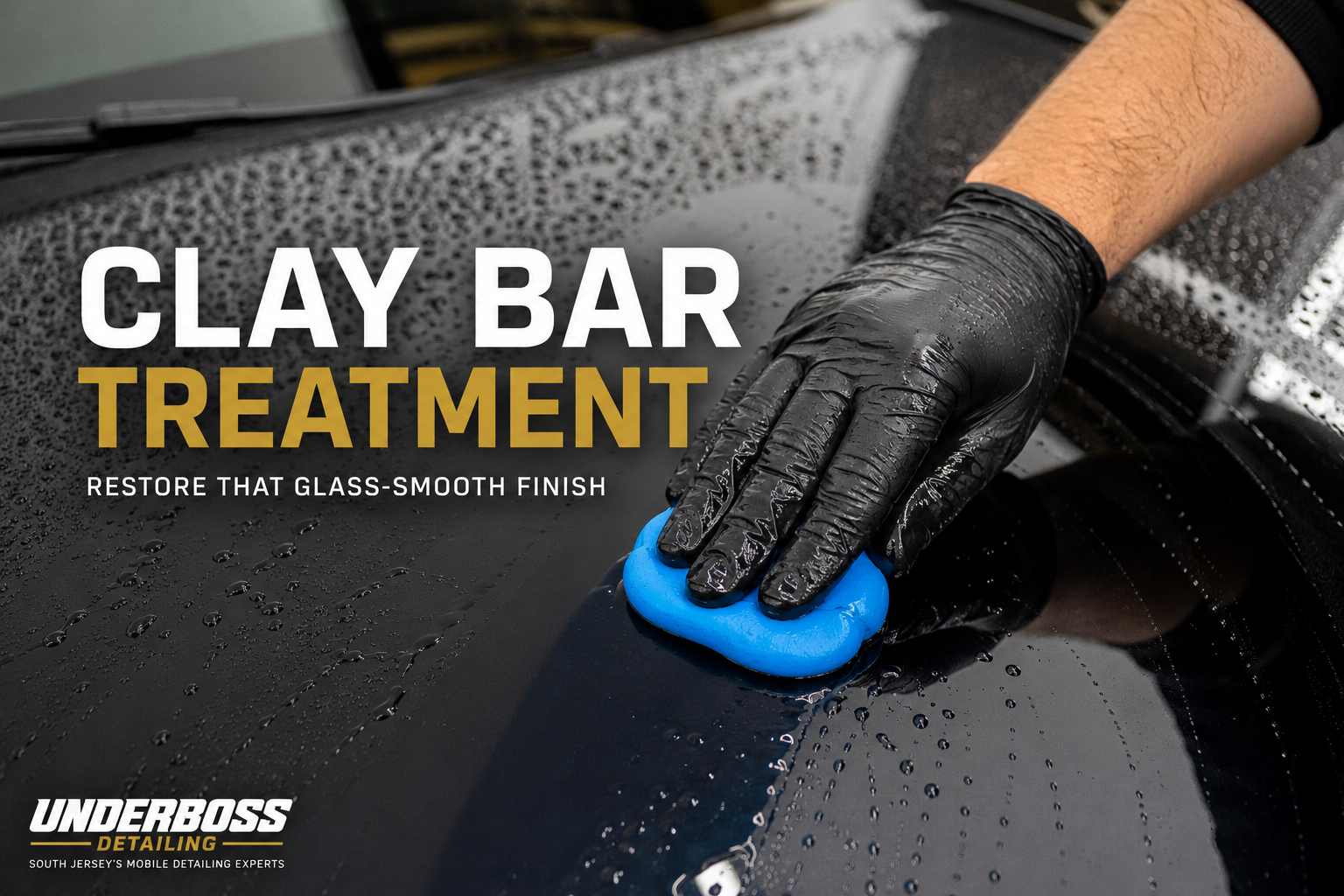
With the car washed and chemically decontaminated, the clay bar process begins. A section of paint is sprayed liberally with clay lubricant, and the clay bar is worked across the lubricated surface in overlapping back-and-forth passes with light pressure.
Using clay without enough lubrication increases the risk of light surface marks, especially on softer clear coats. The lubricant isn't optional — it's what allows the clay to glide safely while still maintaining the grip required to extract particles from the clear coat. More lubricant is always better than not enough. Chemical Guys
As the clay passes over contaminated paint, it visibly collects the particles it removes. Inspect the clay frequently — if it turns orange, the fallout is being removed from the car surface. Repeat until smooth, then wipe with a clean microfiber cloth. The clay is folded regularly to expose a fresh, clean surface and prevent any captured contamination from being dragged back across the paint. Panda Hub Car Care
Each section is wiped clean with a microfiber towel before moving to the next. The difference in texture is usually perceptible panel by panel — run your hand across a freshly clayed section and compare it to an untreated one.
Step 4: Surface Inspection and Polish (If Needed)
After clay bar treatment, the paint surface is inspected under direct lighting for any remaining defects — swirl marks, light scratches, and oxidation that the clay bar revealed but didn't remove. Clay removes contamination; it doesn't remove paint defects. Those require polishing.
Claying must always be performed before polishing when prepping for any coating. Removing bonded contamination first prevents dragging debris across paint and creating new defects. If polishing is performed on contaminated paint, the abrasives in the polish drag those embedded particles across the clear coat — creating new scratches in the process of trying to remove old ones. Jimbo's Detailing
Step 5: Protection Application
Clay leaves paint unprotected. An unprotected paint surface after clay is more vulnerable to contamination than before. Always apply protection the same day. Finddetailing
This is one of the most important — and most commonly misunderstood — aspects of clay bar treatment. The process that makes your paint feel so smooth also strips away any existing wax, sealant, or protection that was on the surface. Freshly clayed paint is chemically clean and exceptionally receptive to bonding with protective coatings, but it's also completely exposed.
Wax and ceramic coatings rely on direct contact with the paint surface. After claying, the paint becomes significantly smoother, creating a critical surface for achieving high-end detailing results. Contaminants often contain chemical residues — clay removes these residues, creating a chemically stable surface for application. A properly prepared surface allows coatings to last longer. Brilliatech
Whether the protection applied is carnauba wax, a synthetic sealant, or a full ceramic coating, it will bond more effectively, last longer, and perform better on freshly clayed paint than on any other surface. This is why professional detailers consider clay bar treatment non-negotiable before any coating application.
Clay Bar Treatment as the Foundation of Any Real Detail
Clay bar treatment should be part of any full detail service. If a detailer isn't claying before polishing or applying coating, they're cutting corners. Finddetailing
This is the professional standard — and it's worth understanding why. Every step that follows clay bar treatment is only as good as the surface it's applied to. Polish applied over contamination creates new damage. Ceramic coating applied over contamination bonds to the contaminant rather than the paint, compromising both adhesion and longevity. The success of a ceramic coating depends far more on the preparation than on the coating itself. If you skip claying, the coating will not bond correctly — no matter how expensive or advanced the product is. Brilliatech
Clay bar treatment is the reset. It establishes the clean, smooth baseline that everything else — polishing, waxing, sealant, ceramic coating — depends on for optimal performance.
How Often Does Your Car Need Clay Bar Treatment?
Most detailers recommend a clay bar treatment once or twice per year, depending on how and where you drive. AutoLaundry
For South Jersey and Philadelphia drivers, the answer skews toward the more frequent end of that range. The combination of heavy winter road salt, industrial fallout from dense traffic corridors, summer tar from hot road surfaces, and coastal humidity creates a contamination environment that's significantly more aggressive than the national average.
The practical recommendation for this region: a clay bar treatment as part of your spring post-winter detail to remove the salt season's accumulated contamination, and again in the fall before protective coating is applied for winter. Vehicles that are parked outdoors year-round, driven on highways daily, or parked near rail or industrial zones may benefit from treatment three times per year.
Vehicles driven daily or parked outdoors often accumulate contamination faster. By incorporating claying into your detailing routine a few times per year, you maintain smoother paint, better shine, and stronger protection performance. Chemical Guys
What Clay Bar Treatment Does for Your Car's Value
Post-clay treatment, the paint's finish becomes significantly smoother, the luster is restored, and the overall resale value of the car is elevated. Cougarchemical
Paint condition is one of the primary factors that determines a used car's value, and paint that has been consistently maintained through proper decontamination looks — and is — in genuinely better condition than paint that has accumulated years of bonded contamination. The difference shows in how light reflects off the surface, how deep the color appears, and how the paint feels to the touch.
Beyond aesthetics, clay bar treatment prevents the long-term damage that embedded contamination causes if left untreated. Iron particles that remain in the clear coat continue to oxidize and expand. Acidic contaminants from bird droppings and tree sap continue to etch. Road salt that isn't fully addressed continues to attack. The cost of prevention through regular decontamination is a fraction of the cost of paint correction or respray that neglect eventually requires.
Ready to Reset Your Paint? Book With Underboss Detailing.
Clay bar treatment is one of the most dramatically visible improvements in professional detailing — and one of the most important foundational steps in any serious paint care routine. At Underboss Detailing, we include paint decontamination as a core part of our exterior detail process, not an afterthought. We come to you across South Jersey and the greater Philadelphia area, bringing professional-grade products and technique directly to your driveway.
Whether you're preparing your paint for ceramic coating, recovering from a South Jersey winter, or simply want your car to feel as good as it looks — we've got you covered.
Book your detail today at underbossdetailing.com and find out what your paint is capable of looking like when it's actually clean.
Frequently Asked Questions
What does clay bar treatment actually do?
Clay bar treatment removes bonded contaminants from your car's clear coat — particles like brake dust, iron fallout, road tar, tree sap, industrial pollution, and mineral deposits that regular washing cannot remove. It physically lifts these particles out of the paint surface, leaving behind a smooth, glass-like finish that serves as the ideal base for wax, sealant, or ceramic coating.
How do I know if my car needs clay bar treatment?
Try the "baggie test": place your hand inside a plastic sandwich bag and run it over the paint. If you feel bumps or grit, it's time for clay. Other indicators include dull or hazy paint that doesn't respond to washing, visible orange specks on panels or wheels, black tar spots on lower body panels, and uneven water beading on waxed or sealed paint. AutoLaundry
Is clay bar treatment safe for all paint types?
Yes, when performed correctly with adequate lubrication. If you follow the process the manufacturer recommends, it will be safe and non-abrasive. The risk comes from using clay without sufficient lubricant or applying too much pressure — both of which a professional detailer avoids through proper technique and product selection. Ceramic Pro
How often should I get clay bar treatment in New Jersey?
For most South Jersey and Philadelphia area vehicles, twice a year is the recommended minimum — spring to address winter salt accumulation and fall to prep for the next salt season. Vehicles driven on highways daily, parked outdoors year-round, or near rail lines or industrial zones may benefit from three treatments per year.
Can I do clay bar treatment myself?
Yes, DIY clay bar kits are available. The most important factors are using sufficient lubricant at all times, working in small sections, keeping light pressure, and following up immediately with wax or sealant. The risk of DIY is primarily from using too little lubricant, which can cause light scratching. For vehicles being prepared for ceramic coating or paint correction, professional treatment ensures the surface preparation meets the standard those services require.
Does clay bar treatment remove scratches?
No — clay bar treatment removes contamination, not paint defects. Scratches, swirl marks, and oxidation in the clear coat require polishing to address. Clay is often performed before polishing as part of a full detail process: clay first to decontaminate the surface, then polish to correct defects, then protective coating to seal the results.
Why do I need to apply wax or coating after clay bar treatment?
Clay leaves paint unprotected. An unprotected paint surface after clay is more vulnerable to contamination than before. Always apply protection the same day. The clay bar process strips any existing protection alongside the contamination. Freshly clayed paint is exceptionally receptive to protective coatings — wax, sealant, or ceramic coating applied after clay bonds more effectively and lasts longer than on any other surface. Finddetailing