How Ceramic Coating Protects Your Car Year-Round in Philadelphia
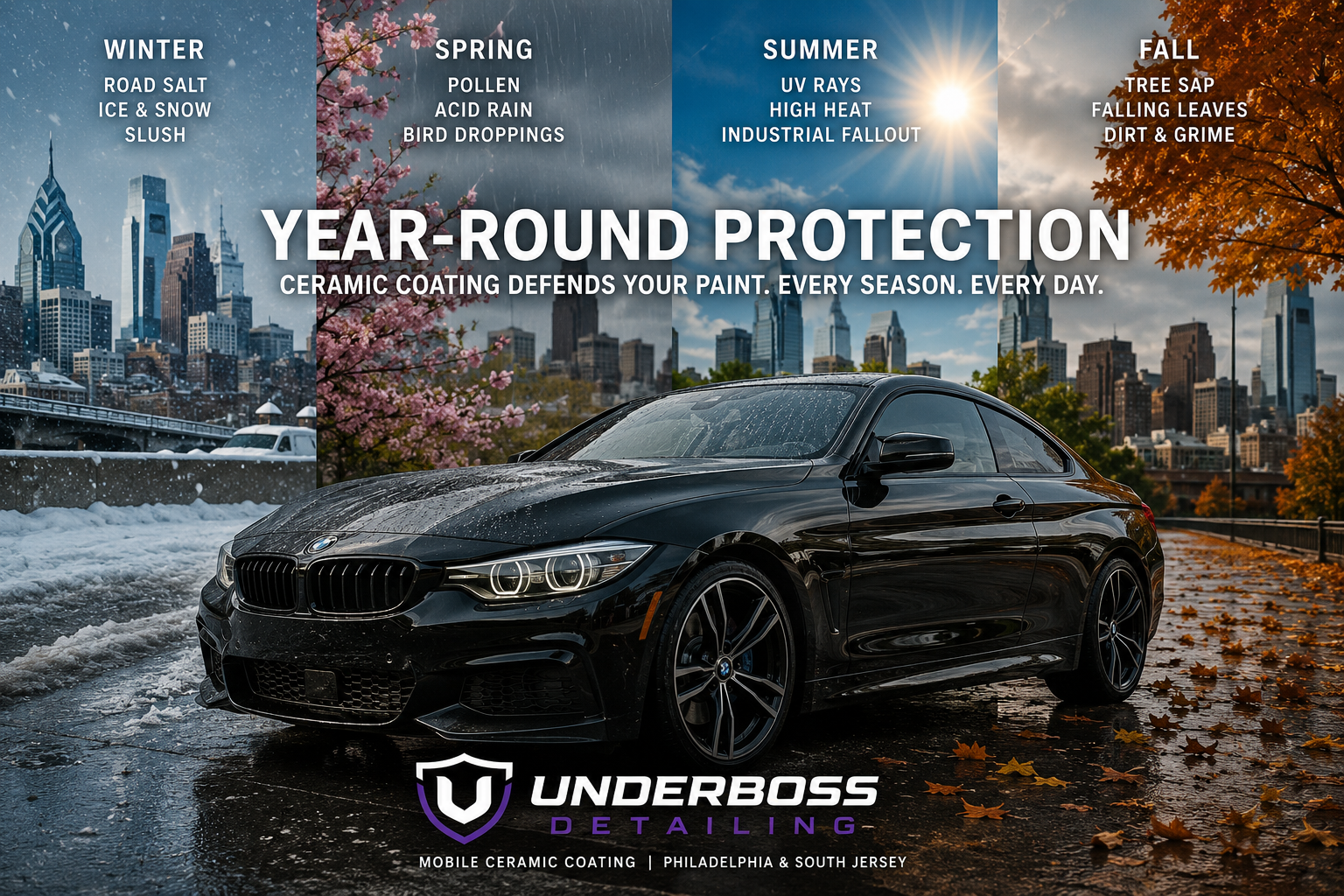
Why Philadelphia Is Particularly Hard on Your Paint
Philadelphia is a great city to drive in — and a brutal one to park in. Between the potholes on the Vine Street Expressway, the tight South Philly streets, the brutal humidity of July, and the salt-caked interstates of January, vehicles in the Philadelphia metro area deal with one of the most aggressive combinations of environmental threats on the East Coast.
Most drivers think about car protection reactively — they notice the fade, the rust bubble, the dull clear coat — and then they do something about it. By then, the damage is already done and reversal is expensive. Ceramic coating flips that approach entirely. It's one of the few car care investments that works best before the damage happens, and when applied professionally, it addresses every seasonal threat Philadelphia and South Jersey throw at a vehicle — all at once, all year long.
This guide breaks down exactly how ceramic coating works, what it protects against in this specific climate, and why it's become the standard choice for drivers who want to protect their investment long-term.
What Ceramic Coating Actually Is
Before getting into what it does, it helps to understand what it is — because there's a lot of confusion between ceramic coating, wax, and the spray-on "ceramic" products sold in auto parts stores.
Ceramic coating is a liquid polymer applied to a car's exterior to provide exceptional protection for the paint and surface. This cutting-edge technology creates a transparent layer that chemically bonds with the car's factory paint, ensuring long-lasting durability and resistance to environmental damage. It shields the paint from scratches, oxidation, and contaminants such as bird droppings and tree sap. Colorado Clear Bra
The key word is chemically bonds. The key difference between ceramic coating and traditional protection like wax or sealant is permanence. Wax sits on the surface and washes off within weeks. Ceramic coating bonds chemically and cannot be removed by washing, rain, or normal environmental exposure. Professional-grade coatings last years, not months. Auto Cosmetics
SiO2 — silicon dioxide — is the active ingredient that creates the hardened protective layer. Higher concentration means a harder, more durable coating. Consumer sprays contain 70% to 85% SiO2. Professional coatings use 93% to 97%, producing a coating that lasts years instead of months. Auto Cosmetics
In other words, the professional-grade ceramic coating applied by a detailer is a fundamentally different product than the spray bottle you find at a big-box auto store, even if both use the word "ceramic" on the label.
Philadelphia's Four Seasonal Threats — And How Ceramic Coating Handles Each One
Winter: Road Salt and Chemical Deicers
Philadelphia winters mean road salt — and lots of it. Every snowstorm sends PennDOT trucks out across I-76, I-95, Route 1, and every side street in between. South Jersey gets the same treatment across Routes 42, 295, and 55.
PA winters bring snow and ice, and lots of road salt. While this de-icing tactic keeps roads safer, it can wreak havoc on your car's clear coat and paint. Salt and chemical deicers promote corrosion, especially when they sit on unprotected surfaces. Prestigeaa
Here's where ceramic coating changes the equation entirely. A professionally installed ceramic coating creates a hydrophobic surface that repels road salt and brine. Because contaminants struggle to bond, maintenance becomes easier and safer — weekly washes remove buildup more effectively, reducing the risk of scratching. Prestigeaa
The physics of this matter. Salt causes damage by bonding to the clear coat and trapping moisture against it. A ceramic-coated surface is so slick and hydrophobic that salt struggles to get a foothold. When you do wash the car — which you still should, regularly — the salt comes off far more completely than it would from bare or waxed paint.
Spring: Pollen, Acid Rain, and Contaminants
The Philadelphia region is notorious for spring pollen season. Oak, birch, and grass pollen coat every outdoor surface in a fine yellowish film for weeks on end. Beyond looking terrible, pollen is mildly acidic and can etch into unprotected clear coat when it sits in moisture.
Add to that the acid rain component. Summers and transitional seasons in Pennsylvania are hot, humid, and often include acid rain. The intense UV rays can fade paint, while the moisture and acidic pollutants cause oxidation and surface contamination. Prestigeaa
Ceramic coating's chemical resistance directly addresses this. The SiO2 layer prevents bird droppings, tree sap, bug acids, and mineral deposits from bonding to the paint surface and causing etching. Pollen, tree sap, and acidic rain still land on your car — but they sit on top of the coating rather than bonding to your paint, and they wash off far more easily. Auto Cosmetics
Summer: UV Rays and Heat
Philadelphia summers are legitimately harsh — consistent heat, high humidity, and UV index readings that bleach and oxidize unprotected automotive paint over months and years of exposure.
Pennsylvania's seasonal humidity and year-round sun exposure increase the risk of paint oxidation. UV radiation penetrates clouds and reflects off snow, breaking down the clear coat year-round — not just in summer. Prestigeaa
This is a point worth emphasizing: UV damage isn't only a summer problem. Philadelphia drivers accumulate UV exposure year-round, including off reflective snow cover in winter. The SiO2 oxide layer blocks ultraviolet radiation that causes paint oxidation, fading, and chalking. Auto Cosmetics
The result on unprotected paint is familiar to anyone who has owned a car for several years in this region — that hazy, dull look that no amount of washing seems to address. That's oxidation of the clear coat, and once it sets in significantly, it requires paint correction to reverse. Ceramic coating prevents it from taking hold in the first place.
Car manufacturers continue to cut costs and vehicles are being produced with less and less paint year after year. If you do not protect newer cars with very thin paint, they are going to oxidize at a record pace. If you bought your car in the last five years, the factory paint protecting it is thinner than it's ever been — which makes ceramic coating more relevant, not less. Fortworthautodetail
Fall: Leaf Tannins, Tree Sap, and Pre-Winter Prep
Fall in the Philadelphia area is beautiful and genuinely damaging to your car's finish. Falling leaves carry tannins — acidic compounds that stain paint and clear coat when they sit wet for extended periods. Tree sap follows the same pattern: sticky, acidic, and capable of etching permanently into unprotected surfaces in days.
Leaves contain sap and acids that can stain paint, while moisture buildup leads to mold and mildew. Fall is the ideal time for a paint sealant or ceramic coating to prepare your car for the coming winter by adding a strong protective layer. Sirdukepgh
For vehicles already coated, fall maintenance is significantly simpler — leaf debris and sap wash off without the intensive attention they'd require on bare paint. For vehicles without a coating, fall is one of the two best times to get one applied, immediately before salt season begins.
Ceramic Coating vs. Wax: Why the Comparison Isn't Even Close
Most drivers have waxed their car at some point, and many assume it's roughly equivalent to ceramic coating — just older technology. It isn't.
Wax lasts only 1 to 3 months before requiring reapplication and doesn't hold up well against harsh weather, extreme temperatures, or frequent washing. Ceramic coating provides a much stronger barrier against weather, chemicals, and UV damage, and maintains its gloss for years without dulling. August Precision
The financial math matters here too. You'll wax your car 20 times over five years compared to one ceramic coating application. If you wax your car four times per year for three years, you could easily spend more than the cost of a one-time ceramic coating application. The ceramic coating's longevity makes it more cost-effective for individuals who plan to keep their cars for several years. FEYNLAB®Huntersdetailing
A $1,500 professional ceramic coating installation lasting 5 years costs $300 annually, while premium wax requiring monthly application at $25 per treatment totals $300 annually with significantly inferior protection. You end up spending the same amount — and getting dramatically less out of it. FEYNLAB®
There's also the maintenance burden to consider. Wax requires consistent reapplication — which, in a Philadelphia winter, often means either waxing in the cold (which affects product performance) or skipping it during the exact months your paint needs it most. Ceramic coating doesn't have that problem. It's there all the time, in every condition, without any additional work on your part beyond regular washing.
The Hydrophobic Effect: Why It Matters More Than It Sounds
One of ceramic coating's most talked-about properties is hydrophobicity — the way water beads up and rolls off the surface rather than sheeting across it. People tend to focus on how impressive this looks, which it does, but the practical protection it provides is more significant than the visual effect.
When water sheets across unprotected paint, it carries with it dissolved contaminants — road salt, bird dropping residue, industrial fallout, mineral deposits from hard water — and it leaves them behind as it evaporates. Those deposits sit on the clear coat, concentrating their corrosive or acidic properties on a single spot. Water spots, mineral etching, and accelerated oxidation all result from this process.
On a ceramic-coated surface, water beads into tight droplets and rolls off, carrying dirt and contaminants with it. This dramatically reduces cleaning effort and frequency. Auto Cosmetics
In a Philadelphia context, this means every rainstorm actually rinses your car rather than depositing contaminants on it. Every winter rinse after salt exposure is more complete. Every summer bird dropping lands on a surface it can't etch into before you get a chance to wash it off.
Professional vs. DIY: Why Application Quality Determines Everything
Walk into any auto parts store and you'll find spray ceramic products for $30 or $40. They're not the same thing as a professionally applied coating, and it's worth understanding why.
Professional detailers charge $1,000 to $3,000 depending on vehicle size and coating choice. This includes comprehensive paint correction and expert application. The benefits include guaranteed professional results, paint correction expertise, proper curing environment, and often a warranty on the work. FEYNLAB®
The paint correction step is critical and is the most commonly skipped part of DIY application. Ceramic coating bonds to whatever surface it's applied to — which means if your clear coat has swirl marks, fine scratches, oxidation, or embedded contamination, the coating locks all of that in. Improper DIY application may require complete coating removal and professional reapplication, ultimately costing more than choosing professional installation initially. FEYNLAB®
Professional application means the paint is properly decontaminated and corrected before a single drop of coating goes on. The result is a flawless, glass-smooth surface under a coating that bonds correctly and performs at its rated lifespan — not a mediocre surface under a coating that's been applied over existing damage.
Professional coatings are commonly rated from 2 to 7 years, with real-world performance tied to proper surface correction and maintenance. A professionally applied coating on a properly prepared surface will outlast a DIY application on uncorrected paint by years. Envy This Detailing
How Long Does Ceramic Coating Last?
Professional ceramic coatings last 2 to 5 years, with premium formulations offering 5 to 7 years of protection. The range depends on the product grade, the quality of the surface preparation, how the vehicle is maintained afterward, and driving conditions. FEYNLAB®
For Philadelphia and South Jersey drivers — daily commuters, city parkers, highway drivers — a professional coating applied to a properly prepared surface typically performs toward the upper end of its rated range when maintained correctly. "Maintained correctly" in this context means hand washing with pH-neutral soap, avoiding automatic brush car washes, and periodic inspections to ensure the coating is performing as expected.
Avoid using harsh chemicals, abrasive sponges or brushes, and never go through automatic brush car washes. Always hand wash a ceramic-coated vehicle, and wash the car regularly — once every 1 to 3 weeks — to avoid letting dirt and grime build up on the coating's surface. GlassParency
What Ceramic Coating Doesn't Do
Ceramic coating is exceptional protection. It is not armor plating. Being clear about what it doesn't do is important for setting accurate expectations.
Ceramic coating will not prevent rock chips or deep scratches. A stone kicked up on I-95 will still chip paint — the coating simply makes the chip less likely to spread or rust as quickly. For protection against physical impact, Paint Protection Film (PPF) is the complementary product, and many drivers in this region use both: PPF on high-impact areas like the front bumper and hood, ceramic coating across the full vehicle for environmental protection.
Ceramic coating also won't reverse existing damage. Scratches, oxidation, and paint defects that are present at the time of application need to be corrected before the coating goes on — hence the importance of a professional application that includes proper paint correction as a prerequisite.
The Resale Value Case for Ceramic Coating
Beyond day-to-day protection, ceramic coating is a genuine investment in your vehicle's long-term value. Paint condition is one of the primary factors buyers evaluate when purchasing a used vehicle, and a car that has been coated and properly maintained throughout its life shows dramatically better than one that hasn't — even at the same mileage.
The nano-ceramic particles in the coating create a strong shield against environmental aggressors, UV damage, and daily wear and tear, ensuring your car maintains its brilliance and defense regardless of the season. Over a five-year ownership period, that consistent protection means less oxidation, no rust bubbling from untreated salt damage, interior-quality paint gloss still present at resale — all of which translate directly to higher buyer confidence and a stronger asking price. Ccadetailing
A well-maintained exterior enhances your car's resale appeal, showing potential buyers that it's been cared for properly. You'll also spend less time polishing and detailing since dirt, water, and grime have a harder time sticking to the surface. Prestigeaa
When Is the Best Time to Get Ceramic Coating Applied in the Philadelphia Area?
The two ideal windows are spring and fall — and for different reasons.
Spring (April–May) is ideal after the winter salt season has ended. The vehicle can be fully decontaminated and paint-corrected to remove all winter damage, then coated before the summer UV and heat season begins. You get a clean slate going into the most UV-intensive months.
Fall (September–October) is the other prime window. Getting coated just before the first freeze means your paint enters winter with full hydrophobic protection against road salt from day one of the salt season. This is arguably the highest-value timing for Philadelphia and South Jersey drivers — it's the moment when the coating's salt-repelling properties matter most.
The one timing caveat: ceramic coating requires a curing period of 24 to 48 hours after application during which the vehicle shouldn't get wet. Planning the appointment around a clear weather window is important, which is another advantage of working with a professional who can help time the service correctly.
Protect Your Philadelphia-Area Vehicle Before the Next Season Hits
Ceramic coating isn't a luxury — it's the most complete, longest-lasting paint protection available for vehicles operating in the Philadelphia and South Jersey climate. One professional application handles UV, road salt, acid rain, pollen, tree sap, bird droppings, and daily contaminants simultaneously, for years at a time, without the constant reapplication that wax demands.
Underboss Detailing brings that protection directly to you. We're South Jersey and Philadelphia's premier mobile detailing service — no shop visit, no waiting, no inconvenience. We come to your home or office, handle everything from full paint decontamination and correction to professional ceramic coating application, and leave your vehicle protected for years to come.
Ready to stop fighting your environment one wax job at a time? Book your ceramic coating appointment at underbossdetailing.com and find out what your car is truly capable of looking like — and staying like.
Frequently Asked Questions
What is ceramic coating and how does it work?
Ceramic coating is a liquid polymer — primarily silicon dioxide — that chemically bonds to your car's clear coat when applied. Unlike wax, which sits on top of the surface and washes off within months, ceramic coating becomes part of the paint surface, creating a hard, transparent, hydrophobic layer that repels water, salt, UV rays, and environmental contaminants for years.
How long does ceramic coating last on a car in the Philadelphia area?
Professional ceramic coatings typically last 2 to 7 years depending on the product grade and how well the surface was prepared before application. In the Philadelphia and South Jersey climate — with its combination of winter salt, summer UV, and year-round humidity — a professionally applied coating on properly corrected paint performs toward the upper end of its rated lifespan when maintained with regular hand washing.
Is ceramic coating worth it in New Jersey and Pennsylvania winters?
It's particularly valuable in this climate precisely because of the winters. Ceramic coating creates a hydrophobic barrier that prevents road salt and chemical deicers from bonding to your paint surface, making every wash more effective and dramatically reducing the corrosion risk that South Jersey and Philadelphia winters create for unprotected vehicles.
What's the difference between ceramic coating and a regular car wax?
Wax sits on top of paint and washes off within 1 to 3 months. Ceramic coating chemically bonds to the clear coat and cannot be removed by washing or normal environmental exposure. Ceramic coating provides far superior and longer-lasting protection against UV, chemicals, road salt, and contaminants — and over several years of ownership, it's comparable in cost to repeated waxing while delivering dramatically better results.
Can I apply ceramic coating myself?
DIY ceramic coating products exist, but professional application produces significantly better results for one critical reason: the surface preparation step. Ceramic coating bonds to whatever it's applied over, meaning any scratches, oxidation, or contamination in the paint at the time of application get locked in permanently. Professional detailers perform full paint correction before coating, ensuring the product bonds to a flawless surface and performs at its rated lifespan.
Does ceramic coating prevent rock chips and scratches?
No — ceramic coating is not physical impact protection. It won't prevent chips from road debris or deep scratches from contact. For that level of protection, Paint Protection Film (PPF) is the right product. Many drivers use both: PPF on high-impact zones like the front bumper, hood leading edge, and mirrors, with ceramic coating applied across the full vehicle for environmental protection.
How do I maintain a ceramic-coated car?
Hand wash with a pH-neutral car wash soap every 1 to 3 weeks. Avoid automatic brush car washes, which can degrade the coating over time. Don't use harsh chemical cleaners or abrasive wash mitts. With proper maintenance, the coating continues to perform at full effectiveness throughout its rated lifespan.
When should I get ceramic coating applied?
Spring and fall are the two ideal windows. Spring allows full decontamination and correction after the salt season before summer UV begins. Fall provides maximum protection entering the salt season. Either way, plan for a 24 to 48 hour curing window after application where the vehicle stays dry — which a professional detailer can help you time correctly around the weather.