Clay Bar Treatment Explained — What It Does and When You Need It
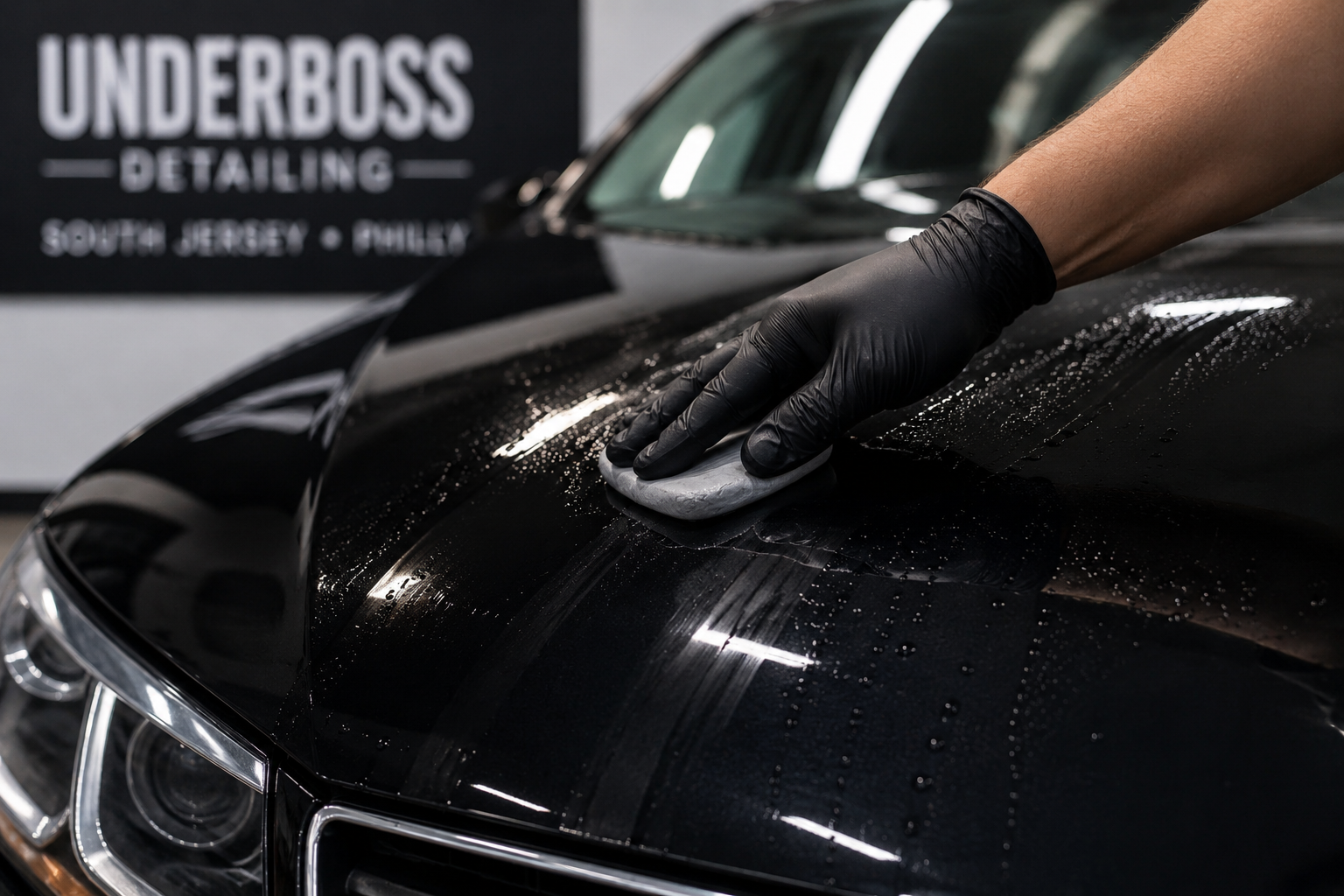
Here's a quick test you can do right now. The next time you wash and dry your car, run your hand across the paint on the hood or the roof. It looks clean and shiny — but does it feel clean? If you notice a faint roughness, a grittiness like fine sandpaper or dried rice, that texture is telling you something a wash can't fix. Your paint has contamination bonded to it, sitting right there in the clear coat, and no amount of scrubbing will lift it out.
That's exactly the problem a clay bar treatment solves. It's one of the most effective tools in professional detailing, and also one of the most misunderstood by car owners — many of whom have never heard of it, and assume their wash is doing all the cleaning their paint needs. At Underboss Detailing, clay bar treatment is a key part of our exterior and full-detail services across South Jersey and the greater Philadelphia area, and it's often the step that earns the most "I had no idea my paint could feel like that" reactions. So let's explain it properly: what a clay bar is, what it actually does, how the process works, and how to know when your car needs one.
What Is a Clay Bar?
A clay bar is a soft, malleable, engineered resin compound — think of something with the consistency of putty or Play-Doh, but more elastic and resilient. (And no, you can't substitute your kid's Play-Doh; automotive clay is specifically formulated for the job.) When worked across a lubricated paint surface, the clay physically grabs and lifts away contaminants that have bonded to the paint and embedded into or just above the clear coat.
The best way to understand it is by analogy. Claying your car is a bit like exfoliating skin, or lightly sanding a rough piece of wood smooth. The clay's tacky surface grabs the particles sticking up out of your paint and shears them off as it glides across, pulling them into the clay rather than dragging them around. What you're left with is paint that feels like glass.
It's worth knowing that clay comes in different grades, much like sandpaper. Finer, milder clays handle light contamination gently, while coarser, more aggressive clays tackle heavier buildup. A good detailer chooses the right grade for your car's specific condition — aggressive enough to get the job done, gentle enough to protect the paint.
What a Clay Bar Actually Does
The core job of a clay bar is decontamination: removing the bonded particles that washing leaves behind. Let's look at what those particles are and why they matter.
As you drive, your car constantly picks up tiny contaminants that bond to its surface — iron particles from brake dust and rail dust, industrial fallout, tree sap residue, road tar, water-scale minerals, overspray, and embedded road grime. These don't just sit loosely on top like ordinary dust. They embed into and above the clear coat, and the physics of why washing can't remove them is simple: water and soap flow over the particles, while the clay physically grabs and shears them off. Vigorous scrubbing accomplishes nothing against bonded contamination — you need something tacky enough to physically lift it.
Removing all that does several valuable things for your car.
It restores a glass-smooth surface. This is the most immediately noticeable result. Paint that felt rough and grabby before claying feels slick and glassy afterward. The tactile difference is dramatic, and it's the clearest sign the treatment worked.
It improves gloss and depth. A smooth surface reflects light more evenly. By removing the contaminants that cloud and texture the clear coat, claying makes your paint look deeper, shinier, and more vibrant — almost like restoring a layer of clarity you didn't know you'd lost.
It prevents long-term paint damage. Many of these contaminants — particularly iron particles and acidic substances like tree sap — can cause real harm over time if left embedded, including etching and rust spotting. Removing them protects your paint's health, not just its looks.
It's essential prep for protection. This is the one most people overlook. Wax, sealants, and ceramic coatings all bond far better to a clean, contaminant-free surface. If you apply protection over contaminated paint, you lock those particles in underneath and get an inferior, shorter-lived result. Claying ensures your protection layers adhere properly, last longer, and perform the way they're supposed to. It also benefits the step in between — if you're going to polish, claying first keeps your polishing pads from picking up debris and breaking down prematurely.
What a Clay Bar Does NOT Do
This is important, because it's where expectations often go wrong. A clay bar is a decontamination step, not a correction step. It does not remove or mask scratches, swirl marks, or oxidation. Those defects are in or below the clear coat, and addressing them requires polishing — a completely separate process known as paint correction.
So if your paint has visible swirls under the light, claying won't touch them. What claying does is remove the bonded grime sitting on the surface, which is exactly why it's done before polishing rather than instead of it. Think of clay as the deep-cleaning prep step that gets the surface truly clean, so that whatever comes next — polishing, waxing, or coating — works on a proper foundation.
How a Clay Bar Treatment Works
Here's what a proper professional clay bar treatment looks like, step by step.
First, a thorough wash and dry. The cleaner the surface to start, the safer and more effective the claying. Loose dirt needs to be gone so the clay isn't dragging grit around.
Next, lubrication — which is non-negotiable. The detailer sprays a dedicated clay lubricant (or a quality detail spray) onto the section being worked. This is the single most important safety factor in claying. The lubricant lets the clay glide smoothly instead of dragging or sticking, which is what prevents marring. Plain water doesn't provide nearly enough slip and should never be used as a substitute.
Then the claying itself, section by section. Working in small areas — hood, then roof, then each door, and so on — the detailer gently glides the clay across the lubricated paint in straight-line strokes (not circles). Light pressure is the rule; the clay does the work, not force. After a few passes, you can actually look at the clay and see the gunk it's pulled out of paint you thought was already clean.
Kneading the clay as it goes. As the clay picks up contamination, the detailer folds and kneads it to expose a fresh, clean surface before continuing. A contaminated piece of clay should never be reused on the paint — and if a clay bar is ever dropped on the ground, it's done, because any grit it picks up will scratch the car.
Finally, wipe down, inspect, and protect. Each section is wiped with a clean microfiber towel, and the detailer re-checks the surface (often with the "bag test" — a plastic bag over the hand that amplifies texture) to confirm it now feels like glass. With the paint freshly decontaminated, this is the ideal moment to apply wax, sealant, or a ceramic coating, locking in the clean, smooth result and helping reduce future contamination buildup.
This is also where careful detailers separate themselves from rushed ones. Claying properly takes patience and attention, working every inch of the vehicle in small sections rather than racing through it.
When Does Your Car Need a Clay Bar?
The simplest answer is the test from the very beginning of this article. Wash and dry your car, then run your hand — ideally inside a thin plastic sandwich bag, which amplifies the texture far beyond what bare skin detects — across the paint, especially the hood and roof. If it feels rough, gritty, or gives a dragging sensation, your paint has bonded contamination and needs claying. If it glides perfectly smooth, you're fine for now.
Beyond the feel test, a few situations make clay bar treatment especially worthwhile:
Before applying any protection. If you're about to wax, seal, or ceramic coat your car, claying first is essential prep. Skipping it means trapping contaminants under your new protection.
Before polishing or paint correction. Claying clears the surface so your polishing work is cleaner and your pads last longer.
Before selling your car. Smooth, glossy, contaminant-free paint noticeably improves how a vehicle looks and feels, which helps its perceived value.
Seasonally, as maintenance. Many detailers recommend claying roughly every six months as part of regular upkeep, though the right frequency depends heavily on where and how you drive. A car parked outdoors near industrial areas, busy roads, or lots of trees will contaminate faster than one kept in a garage.
A word of caution on frequency: because clay is mildly abrasive, you shouldn't clay more often than your paint actually needs. Overdoing it can cause light marring. Claying is a "when needed" treatment, guided by the feel test, not something to do on an aggressive schedule. And one key exception — if your car has a ceramic coating, you should not clay it, as the clay can damage the coating. Coated cars are decontaminated with gentler chemical methods instead.
The Bottom Line
A clay bar treatment is the deep-decontamination step that takes your paint from "washed" to truly clean. It physically removes the bonded iron, tar, sap, and industrial fallout that washing leaves behind — restoring a glass-smooth surface, reviving gloss and depth, protecting your paint from long-term damage, and creating the clean foundation that wax and ceramic coatings need to bond properly and last.
It won't remove scratches or swirls — that's a job for polishing — but as a prep and decontamination step, it's one of the highest-impact, most satisfying things you can do for your car's finish. And the test for whether you need it couldn't be simpler: if your paint doesn't feel like glass after a wash, it's time.
Ready to Feel the Difference?
At Underboss Detailing, clay bar treatment is built into our exterior and full-detail services, and we bring it right to your driveway across South Jersey and the greater Philadelphia area — from Washington Township, Williamstown, Cherry Hill, and Marlton to South Philly, Northeast Philly, Bucks County, and beyond. We use the right clay grade, proper lubrication, and careful section-by-section technique to get your paint glass-smooth and ready for lasting protection, treating every vehicle like it's our own.
Book your appointment today and we'll get you scheduled at a time that works for you. Your car deserves the treatment.
Sources
Chemical Guys — "How to Clay Bar Your Car Properly to Decontaminate Paint" (chemicalguys.com)
Find Car Detailing — "Clay Bar Treatment: What It Does, How to Use It, and When You Need It" (finddetailing.com)
AutoZone — "What Is a Clay Bar and What Can It Do For Your Car?" (autozone.com)
Premier Detailing & Wash — "All About Clay Bar: What It Is, How It Works, & When to Use It" (premierdetailingandwash.com)
Full Speed Mobile Detailing — "What is Clay Bar Treatment" (fullspeedmobiledetailing.com)
CarZone Auto Detailing — "Clay Bar Treatment Explained" (carzoneautodetailing.com)
Lords of Detailing — "Clay Bar Treatment: The Secret to a Smooth and Glossy Car" (lordsofdetailing.com)
Detail King — "How to Clay Bar a Car (The Right Way)" (detailking.com)
Frequently Asked Questions
What does a clay bar do to your car?
A clay bar physically removes bonded contaminants — like iron from brake dust, industrial fallout, tree sap, tar, and road grime — that have embedded in your paint's clear coat and can't be removed by washing. It restores a glass-smooth surface, improves gloss, and preps the paint for wax or coating.
How do I know if my car needs a clay bar treatment?
Wash and dry your car, then run your hand across the paint — ideally with a thin plastic sandwich bag over your hand, which amplifies the texture. If it feels rough, gritty, or grabby, your paint has bonded contamination and needs claying. If it glides smoothly like glass, it doesn't.
Does a clay bar remove scratches and swirls?
No. A clay bar is a decontamination step, not a correction step. Scratches, swirls, and oxidation are in or below the clear coat and require polishing (paint correction) to address. Claying removes what's bonded on top of the surface and is done as prep before polishing.
Can a clay bar damage my paint?
When used correctly with proper lubrication, a clay bar is one of the safest ways to decontaminate paint. Damage happens when there's not enough lubricant, too much pressure, or a dropped/contaminated clay bar is reused. Because clay is mildly abrasive, over-claying can also cause light marring, so it should only be done when needed.
Why is lubrication so important when claying?
Lubrication is non-negotiable. The lubricant lets the clay glide smoothly across the paint instead of dragging or sticking, which is what prevents scratching. Plain water doesn't provide enough slip — always use a dedicated clay lubricant or quality detail spray.
How often should I clay bar my car?
Many detailers recommend roughly every six months as general maintenance, but it really depends on where and how you drive. The best guide is the feel test — clay when your paint feels rough after a wash, not on a fixed aggressive schedule, since over-claying can cause marring.
Should I wax or coat my car after claying?
Yes. Claying leaves the paint freshly decontaminated and bare, making it the perfect time to apply wax, sealant, or a ceramic coating. Protection bonds far better to a clean surface, lasts longer, and helps reduce future contamination buildup.
Can I clay bar a car with a ceramic coating?
No. Clay can damage a ceramic coating, so coated cars should not be clayed. They're decontaminated using gentler chemical methods instead. This is one reason coated vehicles benefit from professional care that knows how to treat them properly.
Is claying the same as washing?
No. Washing removes loose dirt and grime sitting on top of the paint. Claying removes contaminants that have bonded to and embedded in the clear coat — the stuff washing physically can't lift, no matter how thoroughly you scrub.