What Is Paint Decontamination and Does Your Car Need It?
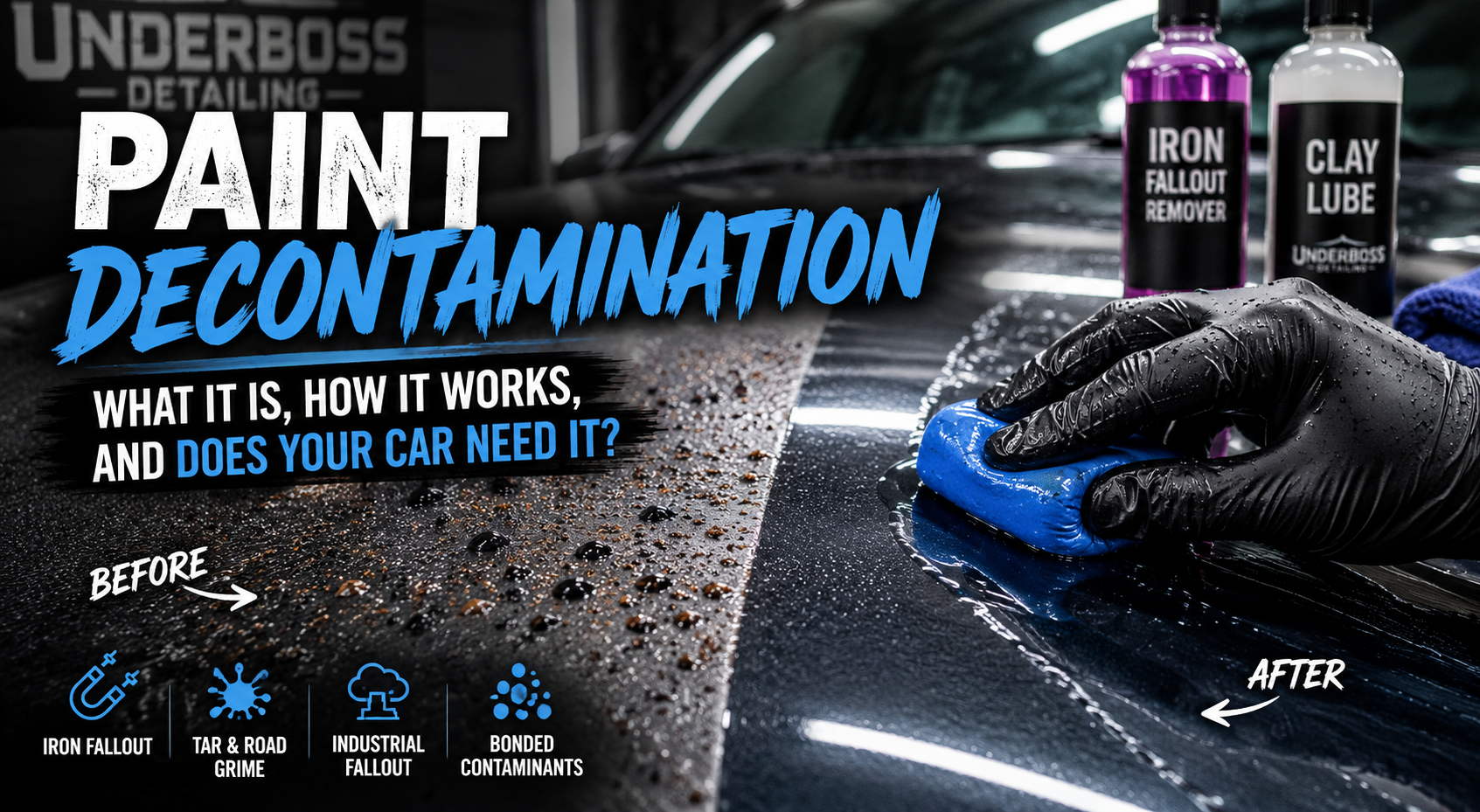
Most people think a good wash is the deepest clean their car's paint can get. You soap it, you rinse it, you dry it, and the surface looks great — so what else is there? As it turns out, quite a lot. Run your hand across your freshly washed paint and you might feel something the shine doesn't reveal: a faint roughness, a grittiness, a texture like very fine sandpaper. That's not dirt, and no amount of washing will remove it. That's contamination bonded into your clear coat — and removing it is exactly what paint decontamination is for.
It's one of the most important steps in professional detailing, and also one of the most overlooked by everyday car owners. At Underboss Detailing, we perform paint decontamination as a core part of our exterior and full-detail services across South Jersey and the greater Philadelphia area, and it's often the step that surprises customers the most — because the difference in how the paint feels and looks afterward is dramatic. So let's break it all down: what paint decontamination actually is, what it removes, how the process works, and how to tell whether your car needs it.
What Paint Decontamination Actually Is
Paint decontamination is the process of removing bonded contaminants that have embedded themselves into your car's clear coat — the kind that regular washing physically cannot lift. A normal wash removes the visible layer of dirt, dust, and grime sitting loosely on top of the paint. Decontamination goes a level deeper, stripping away the contaminants that have chemically or mechanically bonded to the surface over time.
This matters for two big reasons. First, those embedded contaminants gradually degrade your paint, dulling the gloss and, in some cases, causing actual damage like etching or rust spotting. Second, contamination interferes with anything you try to apply on top of your paint. If you wax, seal, or ceramic coat over a contaminated surface, those products can't bond properly — which means you've wasted money on protection that won't last or perform the way it should. Decontamination is the step that ensures a clean, smooth foundation for everything that follows. For anyone serious about preserving their car's finish, it's not optional.
What Gets Stuck in Your Paint
Your car's paint is under near-constant assault from the environment, and a surprising number of contaminants bond to the surface as you drive. Here are the most common culprits.
Iron fallout (brake dust and rail dust). This is the big one. Tiny metal particles from your own brake pads, from passing vehicles, and from rail and industrial sources settle onto your paint and embed themselves. Left untreated, these ferrous particles can actually begin to rust right there in your clear coat, leaving tiny orange or brown spots and causing discoloration over time.
Industrial fallout. Airborne pollutants from factories, construction, and general urban air settle onto and bond with your paint, especially if you park or drive in industrial areas.
Tar and road grime. Sticky road tar flicks up onto your lower panels and hardens, while general road film builds up across the whole vehicle — particularly after winter, when road salt and grime accumulate heavily.
Tree sap. Sap falls onto the surface and hardens, and if left in place it can actually etch into the paint.
Bird droppings and insect residue. Both are acidic, and both can eat into and mar your clear coat if they aren't removed promptly.
Mineral deposits and water spots. Hard water and sprinkler overspray leave behind mineral deposits that bond to the surface and resist normal washing.
The common thread is that all of these bond to your paint over time and become harder to remove the longer they sit. A standard car shampoo simply isn't formulated to break those bonds — you need dedicated decontamination methods.
The Two Types of Decontamination
Professional paint decontamination happens in two stages, and the best results come from doing them in the right order: chemical first, then mechanical.
Chemical Decontamination
The first stage uses specialized products to dissolve contaminants chemically, without any physical contact. The star of this stage is the iron fallout remover. These products contain a reactive agent — usually a thioglycolate compound like ammonium or sodium thioglycolate — that bonds with iron particles and converts them into a water-soluble compound that simply rinses away.
You can actually watch it work. When an iron remover is sprayed onto contaminated paint and left to dwell for a few minutes, it turns purple or red as it reacts with the iron, then rinses clean. (Fair warning: these products famously smell like rotten eggs, thanks to the sulfur in the thioglycolate — that's completely normal.) Dedicated products also exist for tar, bug residue, and mineral deposits, each formulated for a specific type of contaminant.
The reason chemical decontamination comes first is safety. A good iron remover can eliminate a large share of the harmful embedded particles chemically, with zero physical contact — which makes the next stage far safer for your paint.
Mechanical (Physical) Decontamination
The second stage uses physical contact to remove whatever the chemicals couldn't dissolve — things like hardened tar residue, overspray, and bonded mineral deposits. The classic tool here is the clay bar, a soft, malleable material that, when used with plenty of lubricant, gently shears bonded contaminants off the surface as it glides across the paint. A clay mitt accomplishes the same thing and is often faster over large areas.
Here's the critical part that trips up DIYers: you should never jump straight to a clay bar on heavily contaminated paint. If you do, you're essentially dragging microscopic metal shards across your clear coat, which inflicts fine scratches and swirl marks you'll later have to machine-polish out. That's exactly why the chemical step comes first — it removes the dangerous, jagged iron particles so the claying process can safely lift the rest. The two methods achieve a fully decontaminated surface that neither one accomplishes alone.
After claying, a light polish removes any minor marring the clay may have left behind, and a fresh coat of protection locks in the clean result.
How the Full Process Works
Here's what a proper professional decontamination looks like, start to finish:
First comes a thorough wash and dry, removing all the loose surface dirt so the decontamination products can reach what's actually bonded to the paint. Next is the chemical stage — applying iron remover (and tar or bug remover as needed), letting each product dwell, then rinsing thoroughly between different chemistries so the residues don't mix and interfere with one another. Then comes the mechanical stage, working a clay bar or mitt across the paint in small sections, keeping the surface well-lubricated, until the clay glides freely without grabbing — the sign that the section is clean.
Throughout the process, professionals use the "bag test" to check their work: stretching a thin plastic bag over the hand and running it lightly across the paint. The plastic amplifies surface texture far beyond what bare skin can feel. Contaminated paint feels gritty and rough; fully decontaminated paint feels like glass. A good detailer also decontaminates the surfaces people forget — wheel arches, plastic trim, and glass — because iron fallout settles across every exterior surface, not just the body panels.
Finally, the surface is inspected and protected. With the paint now clean and smooth, this is the ideal moment to apply wax, sealant, or a ceramic coating, because the protection will bond properly to a truly clean surface.
One important limit to understand: decontamination and claying address what's bonded on top of your clear coat. They cannot fix what's already embedded in or below it — scratches, swirls, and etching are a job for paint correction, which is a separate process.
Does Your Car Actually Need It?
Here's how to tell. The simplest test is the one above: wash your car, then run your hand (or a plastic bag) across the paint. If it feels rough, gritty, or grabby instead of smooth like glass, your paint is contaminated and would benefit from decontamination.
Beyond the feel test, certain situations make decontamination especially worthwhile. After winter is a prime time, since road salt, grime, and film build up heavily over the season. Before applying any protection — wax, sealant, or especially a ceramic coating — decontamination is essential, because the protection is only as good as the surface it bonds to. Before selling your car, it noticeably improves how the paint looks and feels, raising the vehicle's perceived value. And if you regularly drive through industrial areas or near railways, your paint picks up far more iron fallout than average and needs decontamination more often.
How often? As a general guideline, using an iron remover roughly every three months helps break down particles before they embed too deeply. Chemical decontamination can be done fairly frequently without issue. Claying, however, should be done more sparingly — because it's mildly abrasive, overdoing it can cause micro-marring, so it's best reserved for when the paint genuinely needs it rather than on a fixed schedule.
One key exception: if your car has a ceramic coating, you should not clay bar it. The clay can damage the coating. Coated cars are maintained with gentle chemical decontamination instead, which is one of many reasons coated vehicles benefit from professional care that knows the difference.
The Bottom Line
Paint decontamination is the deep-clean step that washing alone can never accomplish. It removes the bonded iron, tar, sap, and industrial fallout that dull your paint, threaten it with etching and rust, and sabotage any wax or coating you try to apply on top. The two-stage process — chemical first, then mechanical — restores your paint to a glass-smooth surface and creates the clean foundation that every protective product needs to perform.
Does your car need it? If your paint feels anything less than smooth after a wash, the answer is almost certainly yes. And if you're planning to protect your paint with a sealant or ceramic coating, it's not just recommended — it's the step that determines whether that protection actually lasts.
Ready to Give Your Paint a True Deep Clean?
At Underboss Detailing, paint decontamination is built into our exterior and full-detail services, and we bring it right to your driveway across South Jersey and the greater Philadelphia area — from Washington Township, Williamstown, Cherry Hill, and Marlton to South Philly, Northeast Philly, Bucks County, and beyond. We use the proper two-stage process to get your paint glass-smooth and ready for lasting protection, and we treat every vehicle like it's our own.
Book your appointment today and we'll get you scheduled at a time that works for you. Your car deserves the treatment.
Sources
Killer Brands — "Complete Car Paint Decontamination Guide" (killerbrands.co.uk)
Chariotz — "Paint Decontamination After Winter: Iron Fallout, Tar, and Road Film" (chariotz.com)
Car Care Total — "How to Remove Iron Fallout from Car Paint" (carcaretotal.com)
Titan Coatings — "Iron Fallout Remover: A Pro Detailing Guide" (titancoatings.us)
Detailing Shed — "How to Prepare and Decontaminate Your Car" (detailingshed.com.au)
A Miracle Detailing — "Auto Detailing Decontamination" (amiracledetailing.com)
Strong Auto Detail — "What is Paint Decontamination/Clay Baring" (strongautodetail.com)
HyperClean Store — "Why Iron Contamination is Ruining Your Paint" (hypercleanstore.com)
Duel Auto Care — "Is Iron Fallout Remover Necessary?" (duelautocare.co.uk)
Frequently Asked Questions
What is paint decontamination?
Paint decontamination is the process of removing bonded contaminants — like iron fallout, tar, sap, and industrial fallout — that have embedded themselves into your car's clear coat and can't be removed by regular washing. It uses two stages, chemical and mechanical, to restore the paint to a smooth, clean surface.
How do I know if my car needs paint decontamination?
The easiest test is to wash your car, then run your hand (or a plastic bag stretched over your hand) across the paint. If it feels rough, gritty, or grabby instead of smooth like glass, your paint is contaminated and would benefit from decontamination.
What's the difference between washing and decontamination?
Washing removes the loose dirt, dust, and grime sitting on top of your paint. Decontamination goes deeper, removing contaminants that have chemically or mechanically bonded to the surface — the stuff a wash physically can't lift, no matter how thorough.
What is iron fallout and why is it bad?
Iron fallout is tiny metal particles from brake dust, rail dust, and industrial sources that embed in your paint. Left untreated, these ferrous particles can rust right in your clear coat, causing tiny orange spots and discoloration over time. An iron fallout remover dissolves them chemically so they rinse away.
Why does the iron remover smell so bad?
Iron removers contain thioglycolate compounds (usually ammonium or sodium thioglycolate), and the sulfur in them produces a strong rotten-egg smell when the product reacts with iron. It's completely normal and a sign the product is working.
Is clay barring safe for my paint?
Yes, when done correctly with proper lubricant on modern clear coats. The key is doing chemical decontamination first to remove sharp iron particles — jumping straight to clay on heavily contaminated paint can drag those particles across the surface and cause swirl marks. Claying should also be done sparingly, since it's mildly abrasive.
How often should I decontaminate my car's paint?
As a general guide, using an iron remover roughly every three months helps prevent particles from embedding deeply. Chemical decontamination can be done fairly often, but claying should be reserved for when the paint genuinely needs it to avoid micro-marring. Cars driven near industrial areas or railways need it more frequently.
Can I decontaminate a car with a ceramic coating?
You should not clay bar a ceramic-coated car, as it can damage the coating. Coated vehicles are maintained with gentle chemical decontamination instead. This is one reason coated cars benefit from professional care that knows how to treat them properly.
Does decontamination remove scratches and swirls?
No. Decontamination removes what's bonded on top of your clear coat. Scratches, swirls, and etching are already in or below the clear coat and require paint correction, which is a separate machine-polishing process.