How Ceramic Coating Works — And Is It Worth It?
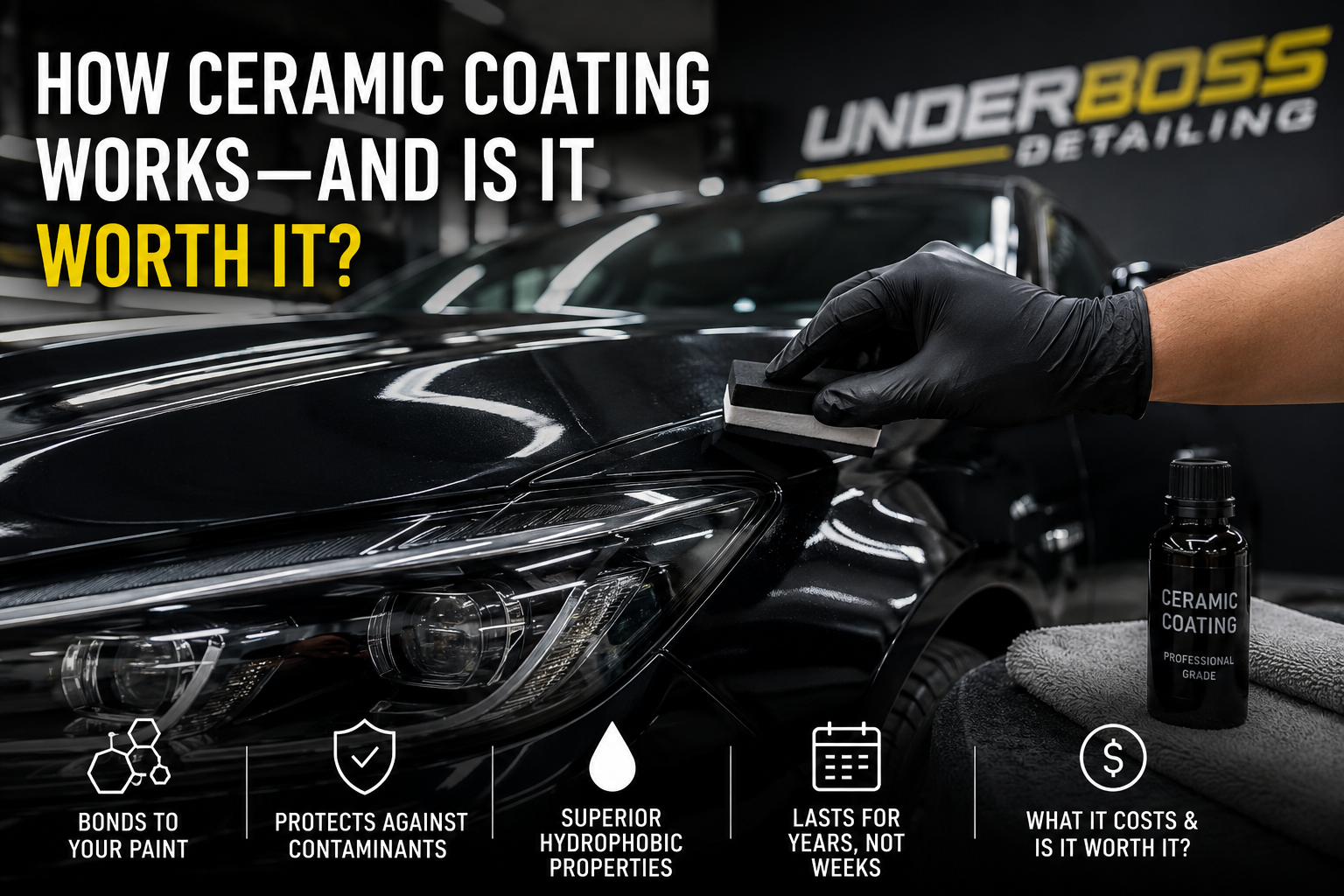
If you've spent any time researching how to protect your car's paint, you've almost certainly run into the term "ceramic coating." It gets thrown around a lot — sometimes as a miracle cure, sometimes as overpriced hype. The truth, as usual, sits somewhere in the middle. Ceramic coating is a genuinely impressive piece of chemistry that can transform how your vehicle looks and how easy it is to maintain. But it's not magic, it's not bulletproof, and whether it's worth the money depends heavily on your car, your habits, and who applies it.
At Underboss Detailing, we apply ceramic coatings across South Jersey and the greater Philadelphia area, and we field these questions constantly. So let's break the whole thing down: what ceramic coating actually is, the science of how it bonds to your paint, what it realistically protects against, what it costs, and finally — the question everyone really wants answered — whether it's worth it for you.
What Is Ceramic Coating, Really?
A ceramic coating is a liquid polymer that you apply to the exterior surfaces of a vehicle. When it cures, it forms a hard, transparent, long-lasting protective layer. The key difference between ceramic coating and old-school wax comes down to how it attaches to your car. Wax simply sits on top of the paint and washes away over weeks. A ceramic coating, by contrast, chemically bonds to the paint at a molecular level, creating a semi-permanent shield that can't be easily washed off.
The active ingredient in most ceramic coatings is silicon dioxide (SiO2), also known as silica, which is commonly derived from natural materials like quartz crystals and sand. Many formulations also include titanium dioxide (TiO2), and some advanced products now incorporate graphene nano-platelets for extra durability. A high-quality bottle of ceramic coating will typically contain at least 80% silica — and as a general rule, the stronger the SiO2 dosage, the harder the coating cures, which boosts its durability.
You'll see ceramic coating referred to by several names — nano-ceramic coating, glass coating, or just "ceramic." They all describe the same basic category of product: a silica-based liquid that hardens into a crystal-clear protective shell.
The Science: How Ceramic Coating Bonds to Your Paint
This is where ceramic coating gets genuinely interesting, and where it separates itself from every wax and sealant that came before it.
The "nano" in nano-ceramic coating refers to the size of the particles involved. Nanotechnology works with materials smaller than 100 nanometers — and to put that in perspective, a single nanometer is one billionth of a meter. One inch contains roughly 25 million nanometers. The SiO2 particles in a ceramic coating are so small that they can penetrate and fill the microscopic pores and imperfections in your car's clear coat. This is why a coated surface feels glassier and looks deeper than an uncoated one: the coating is literally filling in the tiny valleys that scatter light and trap dirt.
The bonding itself is a chemical reaction, not just physical adhesion. When the coating is applied, the SiO2 nanoparticles react with the hydroxyl groups (OH) on the surface of your paint to form covalent bonds. These covalent bonds are far stronger than the weak physical grip that wax has on your paint. The result is a glass-like layer that is both hydrophobic (water-repellent) and oleophobic (oil-repellent).
During application, you'll notice the coating "flashes" or hazes over shortly after it's wiped on. That haze is simply the carrier solvents — often alcohol-based systems like isopropyl alcohol — evaporating away, leaving behind the hardened network of silicon-oxygen bonds. As one detailing chemistry breakdown nicely put it, that water beading you see on a coated car is the visible manifestation of millions of silicon-oxygen bonds working together to protect the surface beneath.
Once cured, the SiO2 forms a robust, silica-based network with a hard, crystalline structure. This is the "shield" everyone talks about — and it's why ceramic coatings can be rated at 9H or even 10H on the pencil hardness scale.
What Ceramic Coating Actually Protects Against
Here's where it's important to be honest, because this is exactly where the hype tends to outrun reality. A ceramic coating does a lot, but it's not an invincible suit of armor. Let's go through what it genuinely does.
Hydrophobic, self-cleaning properties. This is the headline feature. The SiO2 nanoparticles create a high contact angle with water droplets, causing water to bead up and roll right off the surface — carrying dirt, dust, and grime away with it. This "self-cleaning" effect means less dirt sticks to your car in the first place, and what does stick rinses off far more easily. In a wet climate, this is a genuine game-changer, and it can reduce how often you need to wash your vehicle.
UV and oxidation protection. Sunlight is one of the biggest enemies of automotive paint. Over time, UV exposure causes paint to fade and oxidize. The SiO2 (and TiO2) nanoparticles in a ceramic coating block much of that UV radiation, helping preserve your paint's color and your car's resale value.
Chemical resistance. Ceramic coatings provide excellent protection against acidic contaminants — bird droppings, tree sap, acid rain, and road grime. The chemical bonds in the coating help prevent these substances from etching or staining your clear coat, as long as you don't leave them sitting for days on end.
Minor scratch and swirl resistance. This is the most over-promised benefit, so let's be precise. A ceramic coating adds an extra sacrificial layer that can reduce the impact of minor scratches, swirl marks, and marring from daily wear, washing, and light debris. It does not make your car scratch-proof, and it will not stop rock chips or anything with real force behind it. If rock-chip and impact protection is your priority, paint protection film (PPF) is the stronger tool for that specific job — many enthusiasts use both together.
Enhanced gloss and depth. Because the coating fills in microscopic imperfections and creates a smooth, uniform surface, it gives paint a wet-look depth and clarity that wax simply can't match. Your car genuinely looks better coated than not.
How Long Does Ceramic Coating Last?
Durability is one of the biggest reasons people choose ceramic coating over wax — but the numbers vary enormously depending on the product and, critically, who applies it.
Professional-grade ceramic coatings typically last 2 to 5 years, and higher-end formulations or professionally applied multi-layer systems can extend that to 5 to 8 years. Some premium brands advertise 10+ years or even conditional "lifetime" warranties. A well-made coating provides 2 to 3 years of protection at the bare minimum when properly applied and cared for.
DIY ceramic coating kits, by contrast, generally last 1 to 3 years, with a 1-to-2-year lifespan being the more realistic expectation for consumer-grade products. And DIY ceramic sprays — the kind you find in a glovebox-sized bottle — offer the shortest duration, typically 6 to 12 months, and are really meant as maintenance toppers to refresh an existing base coating rather than as standalone protection.
It's worth underlining: ceramic coatings are durable, but they are not permanent. Even the hardest 9H-rated coating will eventually break down at a molecular level, at which point it's best to strip the old coating entirely before applying a fresh layer. And no coating eliminates the need for regular washing — proper maintenance is what determines whether you get the short end or the long end of those durability ranges.
What Does Ceramic Coating Cost?
This is the part that makes people hesitate, and fairly so. Ceramic coating is a real investment.
For professional installation, you're generally looking at $600 to $3,500, with most car owners landing somewhere in the $800 to $2,500 range for a standard sedan or small SUV. Mid-range packages — typically rated for 3 to 5 years — are the most common choice and usually fall between $1,000 and $2,000. Entry-level coatings start around $600 to $800, while high-end, multi-layer systems with extended warranties can exceed $3,500.
DIY kits are dramatically cheaper at roughly $50 to $300, which is the main reason people consider doing it themselves.
So why the enormous gap? The answer is labor and preparation. A significant portion of a professional ceramic coating's price — often 60% to 70% — goes toward surface prep and paint correction. The coating bonds to whatever surface it's applied to, which means if your paint has swirl marks, oxidation, or embedded contaminants, the coating locks those flaws in permanently. Proper prep involves a thorough wash, clay bar decontamination, and often a multi-stage paint correction to remove existing defects. Paint correction alone can add $400 to $1,000+ to the total. A professional ceramic coating service usually takes anywhere from 6 to 24 hours of work, and that time is exactly what you're paying for.
Several factors drive your specific price: vehicle size (a full-size truck or SUV needs more product and time than a compact car), the condition of your paint, the durability tier of the coating, and any add-ons like wheels, glass, or interior coating.
DIY vs. Professional: The Real Tradeoff
The cost gap makes DIY tempting, and for the right person it can make sense. But the tradeoffs are real.
DIY kits cut your upfront cost by roughly 70% to 80% compared to a professional install. The downside is that they demand a substantial investment of your personal time, effort, and learning — and they carry genuine risk. Application errors can lead to streaking, uneven curing, high spots, and hazing, and in a worst-case scenario, mistakes during the prep or correction stage can actually damage your paint. DIY coatings also generally last less time and don't come with warranty coverage.
Professional application, on the other hand, ensures proper surface preparation, optimal bonding, an even finish, and the longest, most reliable durability. Because the coating is permanent once cured, the quality of that initial application essentially locks in your results for years. This is the core argument for going pro: you're not just paying for a bottle of liquid, you're paying for the prep, the expertise, and the assurance that the result is something you'll be happy looking at for half a decade.
So — Is Ceramic Coating Worth It?
The honest answer is: for most people who care about their car, yes — but with realistic expectations.
Consider the math. A $1,500 professional ceramic coating lasting 5 years works out to about $300 per year. Compare that to premium wax applied monthly at around $25 a treatment, which also totals roughly $300 annually — but with significantly inferior protection and far more of your time spent on the job. Mid-range coatings tend to offer the best value, averaging around $375 per year over their lifespan. On top of that, the self-cleaning hydrophobic properties can reduce wash frequency by 30% to 40%, saving you real hours of maintenance time over the course of a year.
Ceramic coating is most worth it if you plan to keep your vehicle for several years, you want to preserve its appearance and resale value, you'd rather wash less often, and you appreciate a deep, glossy finish. It's also a smart move on a new car, where the paint is already in pristine condition and the coating locks that condition in.
It's a weaker value proposition if you lease or flip cars every year, if you genuinely don't care how your car looks, or if your only concern is rock-chip protection — in which case paint protection film is the better tool for that specific need.
The biggest mistake we see isn't choosing ceramic coating — it's choosing it with the wrong expectations, or having it applied over poorly prepped paint that traps flaws underneath a glossy, permanent layer. Done right, on properly corrected paint, by someone who knows what they're doing, a ceramic coating is one of the best investments you can make in your vehicle's long-term appearance and protection.
Ready to Give Your Car the Treatment It Deserves?
At Underboss Detailing, we bring professional-grade ceramic coating and full-service detailing straight to you across South Jersey and the greater Philadelphia area — from Washington Township, Williamstown, Cherry Hill, and Marlton to South Philly, Northeast Philly, Bucks County, and beyond. We handle the prep the right way, because we know that's what makes a coating actually perform. We treat every vehicle like it's our own, at your home, your office, or wherever's convenient for you.
If you're ready to see what your car is truly capable of looking like, book your appointment today and we'll get you scheduled at a time that works for you. Your car deserves the treatment.
Sources
IGL Coatings — "What is Automobile Ceramic Coating?" (blog.iglcoatings.com)
Ceramic Pro — "What Does a Nano Ceramic Coating Do?" (ceramicpro.com)
AvalonKing — "The Truth About Ceramic Coatings" (avalonking.com)
Vetrosol / Ceramic Nano Coatings — "Ceramic Nano Coating Demystified" (ceramicnanocoatings.com)
Bob Moses Ceramic Coating — "The Science Behind Ceramic Coating" (bobmosescc.com)
Olson's Auto Detailing — "The Chemistry of Ceramic Coatings: SiO2, TiO2 & Cross-Linking" (olsonsautodetailing.com)
TopCoat Products — "The Hype Around SiO2" (topcoatproducts.com)
FEYNLAB — "Is Ceramic Coating Worth It?" and "Ceramic Coating Cost" (feynlab.com)
AutoZone — "How Much Does It Cost to Ceramic Coat a Car?" (autozone.com)
Hugo's Auto Detail — "How Much Does Ceramic Coating Cost? Price & Value Guide" (hugosdetails.com)
Advanced Detailing SoFla — "Ceramic Coating Cost: DIY vs Professional" (advanceddetailingsofla.com)
Frequently Asked Questions
How long does ceramic coating last?
A professionally applied ceramic coating typically lasts 2 to 5 years, with higher-end or multi-layer systems reaching 5 to 8 years, and some premium products advertising 10+ years or conditional "lifetime" warranties. DIY kits generally last 1 to 3 years, while DIY ceramic sprays last only 6 to 12 months and are best used as maintenance toppers. The real determining factor is maintenance — regular, proper washing is what pushes you toward the longer end of those ranges.
How much does ceramic coating cost?
Professional installation generally runs $600 to $3,500, with most owners paying $800 to $2,500 for a standard sedan or small SUV. Mid-range packages rated for 3 to 5 years are the most common and usually fall between $1,000 and $2,000. DIY kits cost far less — roughly $50 to $300 — but offer shorter durability and no warranty. The price gap comes mostly from labor and prep, which can account for 60% to 70% of a professional job.
Is ceramic coating worth the money?
For most people who keep their car for several years and care about its appearance, yes. A $1,500 coating lasting 5 years works out to about $300 per year — comparable to monthly waxing but with far better protection and far less effort. It's a weaker value if you lease or flip cars annually, don't care how your car looks, or only want rock-chip protection (in which case paint protection film is the better tool).
Does ceramic coating make my car scratch-proof?
No. This is the most over-promised benefit. A ceramic coating adds a sacrificial layer that resists minor scratches, swirl marks, and marring from daily wear and washing. It will not stop rock chips or anything with real force behind it. For impact and rock-chip protection, paint protection film (PPF) is the stronger option — many enthusiasts use both together.
Can I apply ceramic coating myself?
You can, and DIY kits cut your upfront cost by 70% to 80%. But the tradeoffs are real: it demands significant time and learning, and application errors can cause streaking, hazing, high spots, or even paint damage. Because the coating is permanent once cured, mistakes get locked in. DIY coatings also last less time and carry no warranty. Professional application ensures proper prep, even bonding, and the longest, most reliable results.
Do I still need to wash my car after ceramic coating?
Yes. Ceramic coating makes washing easier and less frequent thanks to its hydrophobic, self-cleaning properties — it can reduce wash frequency by 30% to 40% — but it does not eliminate washing entirely. Regular washing with a pH-neutral, wax-free shampoo is essential to keep the coating performing and to reach its full lifespan.
What does ceramic coating actually protect against?
It provides strong protection against UV rays and oxidation (which fade paint over time), acidic contaminants like bird droppings, tree sap, and acid rain, and it adds water-repellent, self-cleaning properties plus enhanced gloss and depth. It offers modest resistance to minor scratches and swirls, but it is not a shield against rock chips or significant impacts.
Why does professional ceramic coating cost so much more than a DIY kit?
You're not just paying for the bottle of coating — you're paying for surface preparation and expertise, which make up the bulk of the cost. Proper prep includes a thorough wash, clay bar decontamination, and often multi-stage paint correction to remove existing swirls and oxidation. Since the coating permanently bonds to whatever surface it's applied to, this prep is what determines whether your results look flawless or lock in existing flaws. A professional job often takes 6 to 24 hours of work.
How do I know when my ceramic coating needs to be reapplied?
Watch for diminished water beading, increased difficulty cleaning the car, and a noticeable loss of gloss. When the hydrophobic properties fade and dirt starts sticking more easily, the coating has begun to break down. At that point, it's best to strip the old coating entirely before applying a fresh layer rather than coating over a degraded one.
Can ceramic coating be applied to an older car?
Absolutely. Ceramic coating can restore and protect the look of an older vehicle and guard it against further aging. On an older car, proper paint correction beforehand matters even more, since the coating will lock in whatever condition the paint is in when it's applied. Done right, it's a valuable investment at any age.